2026-06-23 愛媛大学
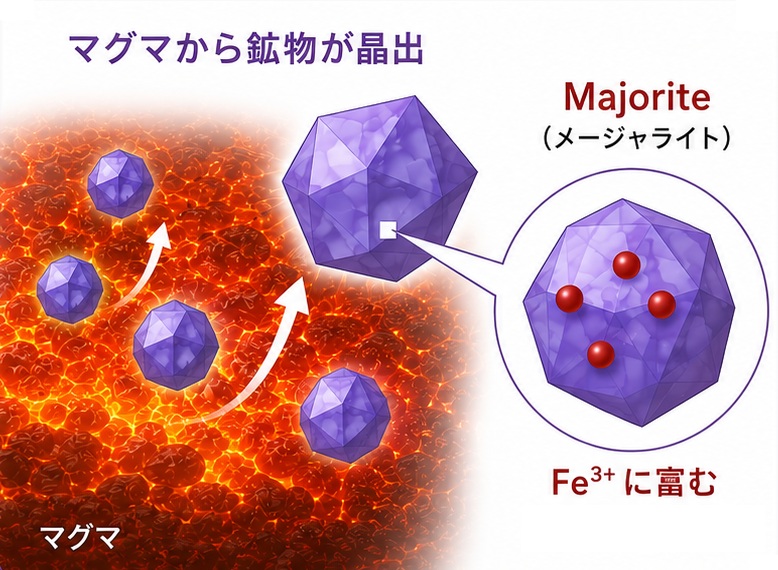
マグマから晶出するFe3+に富むMajoriteのイメージ
<関連情報>
- https://www.ehime-u.ac.jp/data_relese/pr_20260623_grc/
- https://agupubs.onlinelibrary.wiley.com/doi/10.1029/2025JB033231
18 GPaにおいて還元的なメルトと共存するメージャライト中の三価鉄含有量:火星および地球マントルの酸素フガシティへの示唆 Ferric Iron Content of Majorite Coexisting With Reducing Melt at 18 GPa: Implications for the Mantle Oxygen Fugacity of Mars and Earth
Hideharu Kuwahara, Ryoichi Nakada
Journal of Geophysical Research: Solid Earth Published: 16 May 2026
DOI:https://doi.org/10.1029/2025JB033231
Abstract
Knowledge of the Fe3+/ΣFe ratio of mantle minerals crystallized from a magma ocean under high pressures is important to constrain the initial distributions of Fe3+/ΣFe ratio and oxygen fugacity (fo2) of the mantle of terrestrial planets, such as Mars and Earth. Here we experimentally investigated the Fe3+/ΣFe ratio of majorite coexisting with reducing melts at 18 GPa, corresponding to the middle part of the Earth’s mantle transition zone and the base of the Martian mantle. The results show that majorite coexisting with melts has Fe3+/ΣFe ratios ranging from 0.11 to 0.21, with typical analytical uncertainties of ±0.01–0.02, under metal- and diamond-saturated conditions. These values are higher than those of the upper mantle minerals and silicate melts, but lower than in bridgmanite under identical conditions. These results suggest the formation of a vertically heterogeneous distribution of Fe3+/ΣFe ratio in the mantle during magma ocean crystallization. For Earth, after the magma ocean crystallization, the phase transition of Fe3+-rich bridgmanite to majorite in an upwelling mantle flow could release an excess amount of Fe3+ and oxidize the mantle transition zone, generating redox heterogeneity in this region. For Mars, the Fe3+/ΣFe ratio of majorite coexisting with melt under metal-saturated conditions may explain the apparent discrepancy in fo2 between the molten silicate layer above the metallic core and the oxidized surface magmas recorded in Martian meteorites.
Plain Language Summary
The mantle oxidation state of terrestrial planets controls volcanic gas compositions and solidus temperature, which affect the chemical differentiation of the planets. The mantle oxidation state depends on how iron is stored in mantle minerals, either as reduced ferrous iron (Fe2+) or oxidized ferric iron (Fe3+). In this study, we conducted high-pressure experiments at 18 GPa, equivalent to depths of about 500–600 km inside Earth and to the base of the Martian mantle, to investigate how Fe2+ and Fe3+ are distributed between majorite and silicate melt during magma ocean solidification. We found that majorite contains more ferric iron than the magma ocean and the upper mantle minerals, but less than bridgmanite, the dominant lower mantle mineral on Earth. These results indicate that majorite can act as a redox regulator in the Earth’s mantle transition zone, where it may create local variations in oxidation state depending on the downward- and upward-mantle flows. For Mars, our findings suggest that a moderate amount of Fe3+ can be retained in the solid mantle above the reducing molten silicate layer near the core-mantle boundary, helping to explain why Martian rocks record a more oxidized state than expected from the reducing conditions at the core-mantle boundary.