2026-06-17 中国科学院(CAS)
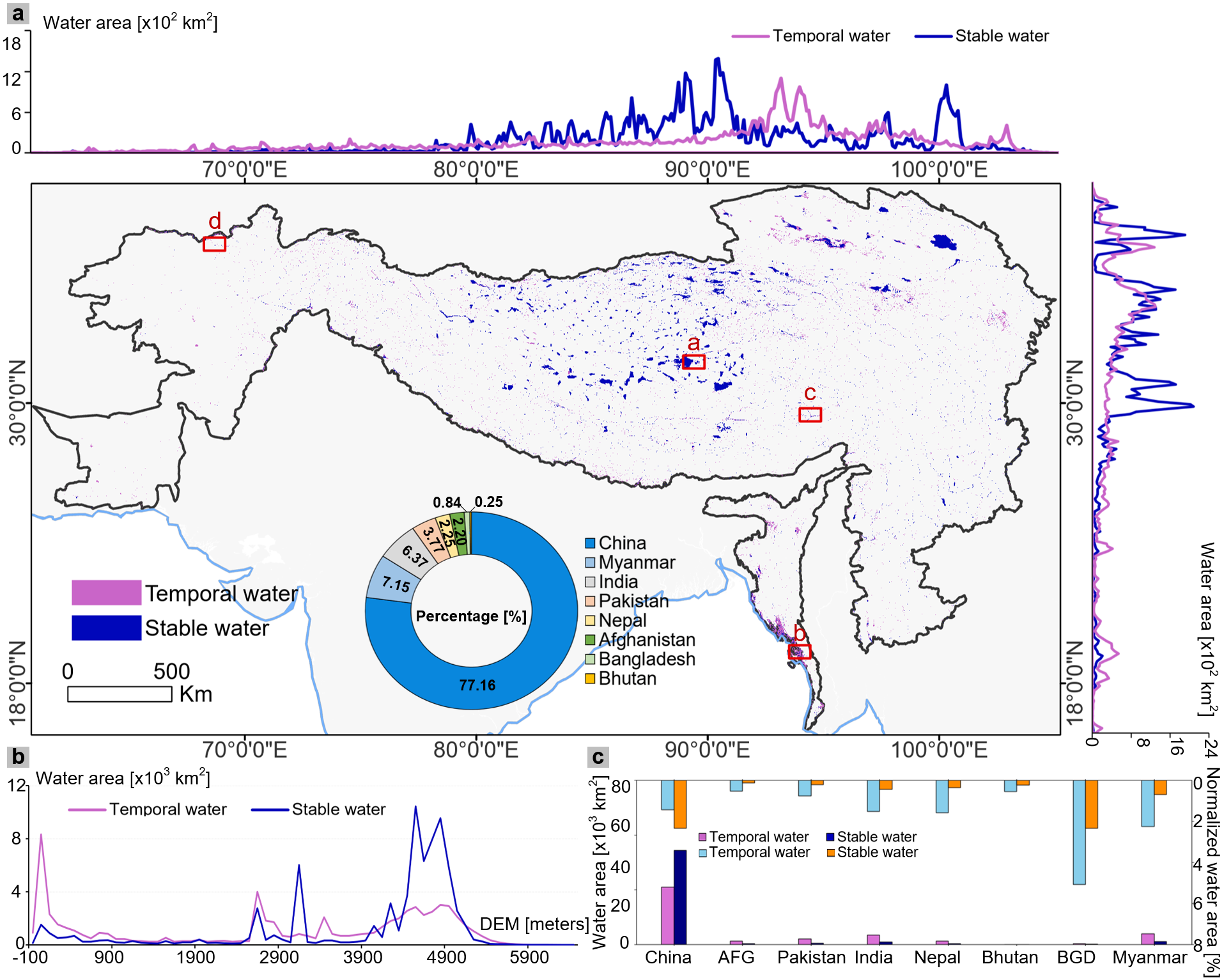
Spatial distribution of DWH10 and statistics of surface water area across the HKH region. AFG denotes Afghanistan and BGD denotes Bangladesh. (Image by AIR)
<関連情報>
- https://english.cas.cn/newsroom/research-news/202606/t20260617_1174046.shtml
- https://www.sciencedirect.com/science/article/abs/pii/S0034425726002075
SDGSAT-1とSentinel-2の観測データを統合した、ヒンドゥークシュ・ヒマラヤ地域における高解像度動的地表水マッピング High-resolution dynamic surface water mapping in the Hindu Kush Himalaya region by integrating SDGSAT-1 and Sentinel-2 observations
Xidong Chen, Shanlong Lu, Bin Chen, Xinya Kuang, Junguo Liu, Liangyun Liu, Congcong Wen, Harrison Odion Ikhumhen, Cong Du, Changyong Dou, Xiao Zhang, Huadong Guo
Remote Sensing of Environment Available online: 28 April 2026
DOI:https://doi.org/10.1016/j.rse.2026.115437
Highlights
- Proposal of a novel Water Dynamic Tracking (WDT) method.
- The SDGSAT-1 nighttime TIR can enhance the contrast between water and terrain shadow.
- Development of a 10-m Dynamic Water body map of the HKH region in 2022 (DWH10).
- HKH contains 145 × 103 km2 surface water, with 53% stable and 47% temporal water.
- This study offers innovative uses of SDGSAT-1 for surface water monitoring.
Abstract
The Hindu Kush Himalaya (HKH) region, known as the “Water Tower of Asia”, plays a critical role in supplying water for 2 billion people across Asia, making the dynamic monitoring of its surface water a key priority for water resource management and sustainable development. However, the HKH region’s complex topography poses significant challenges to accurate surface water monitoring, primarily due to terrain shadow interferences. To date, there has been no accurate dynamic surface water mapping approach tailored to the HKH region’s unique environmental conditions. To address this gap, we propose a novel Water Dynamic Tracking (WDT) method, integrating time-series Sentinel-2 imagery and newly launched Sustainable Development Science Satellite-1 (SDGSAT-1) nighttime Thermal Infrared (TIR) imagery to generate a high-resolution (10-m) Dynamic Water mapping of the HKH region for 2022 (DWH10). Specifically, we first evaluated the sensitivity of SDGSAT-1 nighttime TIR data in distinguishing water bodies from terrain shadows. Training samples were then automatically generated using a combination of multisource datasets and a statistically-based threshold method. Next, locally adaptive eXtreme Gradient Boosting (XGBoost) classifiers were developed across 147 2° × 2° geographical tiles to produce the maximum surface water extent. Temporal and stable water were subsequently identified within this extent using the time-series SDGSAT-1 and Sentinel-2 imagery. Validation against samples from 12 sites demonstrated a high overall accuracy of 95.4% (±1.2%) for detecting both temporary and stable water bodies, and a kappa coefficient of 0.93. Compared with existing datasets (such as the Joint Research Centre Global Surface Water map (JRC-GSW), the Global Land Analysis and Discovery Water map (GLADWater), and the 10-m resolution European Space Agency land cover product (ESA10))—our developed DWH10 exhibited superior performance in dynamic surface water mapping in the HKH region, which identified approximately 145 × 103 km2 surface water (53% were stable and 47% were temporal). This study highlights the effectiveness of SDGSAT-1’s nighttime TIR imagery in differentiating water bodies from terrain shadows, showcasing its great potential for surface water mapping in complex terrains. Additionally, our research fills a critical knowledge gap regarding surface water coverage in the HKH region and offers valuable insights into SDGSAT-1 applications for surface water monitoring. The DWH10 product is publicly available via doi:https://doi.org/10.5281/zenodo.10828610.