2026-06-18 中国科学院(CAS)
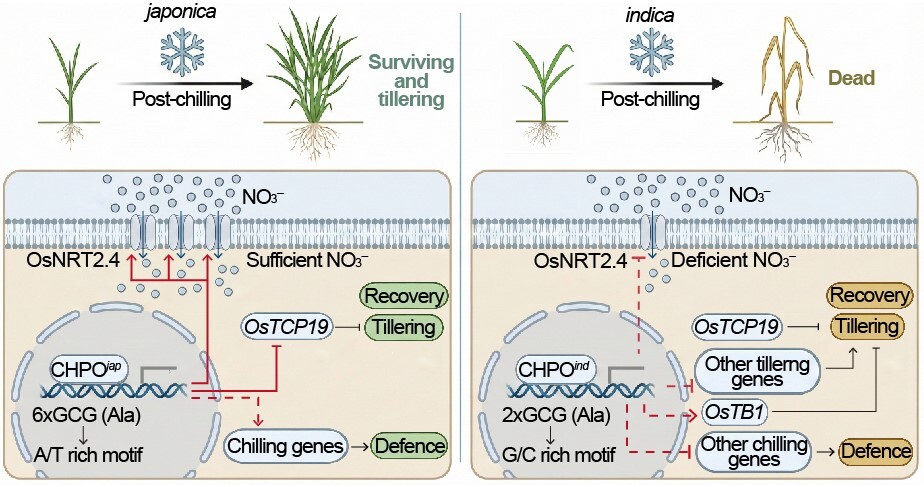
Figure: Molecular mechanism underlying the functional differences Between CHPOjap (left) and CHPOind (right). (Image by CAO Jie)
<関連情報>
- https://english.cas.cn/newsroom/research-news/202606/t20260617_1169146.shtml
- https://www.nature.com/articles/s41586-026-10682-6
CHPOはイネの低温回復と窒素利用を調整する CHPO coordinates chilling recovery and nitrogen use in rice
Jie Cao,Yunyuan Xu,Zhitao Li,Jingdan Han,Qian Qian,Song Ge,Hong Wang,Wei Luo & Kang Chong
Nature Published:17 June 2026
DOI:https://doi.org/10.1038/s41586-026-10682-6
Abstract
Global rice production faces mounting challenges from abnormal temperature fluctuations and nitrogen-fertilizer-driven environmental pollution1,2,3,4,5,6,7. Developing varieties that balance chilling resilience and nitrogen-use efficiency (NUE) offers a promising solution, but the molecular networks coordinating these traits remain poorly understood. Here we identify CHILLING PHOENIX (CHPO), a major gene underlying the quantitative trait locus shared by both chilling tolerance and resilience. It encodes a MYB transcription factor that acts as a key regulator coordinating post-chilling recovery with nitrogen use in rice. Natural variation in a GCG-repeat-encoded polyalanine tract alters CHPO DNA-binding preference and redirects regulatory outputs between the japonica-type (CHPOjap) and indica-type (CHPOind), causing opposing effects on chilling tolerance and resilience. This allelic variation is shaped by domestication selection, with the CHPOjap allele probably derived from Chinese wild rice. CHPOjap directly targets OsTCP19 and OsNRT2.4 to fine-tune NUE, thereby enhancing chilling tolerance and resilience. These findings provide a mechanistic framework for a chilling-induced high-nitrogen-utilization module that alleviates the damage caused by chilling stress, and a potential molecular design strategy for breeding rice varieties with both chilling resilience and high NUE at the recovery stage.