2026-06-17 英国研究イノベーション機構(UKRI)
<関連情報>
- https://www.ukri.org/news/quantum-experiment-opens-gravitational-waves-and-dark-matter-search/
- https://www.nature.com/articles/s41586-026-10617-1
基礎物理学のためのプロトタイプ差動原子干渉計 A prototype differential atom interferometer for fundamental physics
C. F. A. Baynham,R. Hobson,O. Buchmüller,D. Evans,L. Hawkins,L. Iannizzotto Venezze,A. Josset,D. Lee,E. Pasatembou,B. E. Sauer,M. R. Tarbutt,T. Walker,O. Ennis,U. Chauhan,A. Brzakalik,S. Dey,S. Hedges,B. Stray,M. Langlois,K. Bongs,T. Hird,S. Lellouch,M. Holynski,B. Bostwick,AION Collaboration
Nature Published:17 June 2026
DOI:https://doi.org/10.1038/s41586-026-10617-1
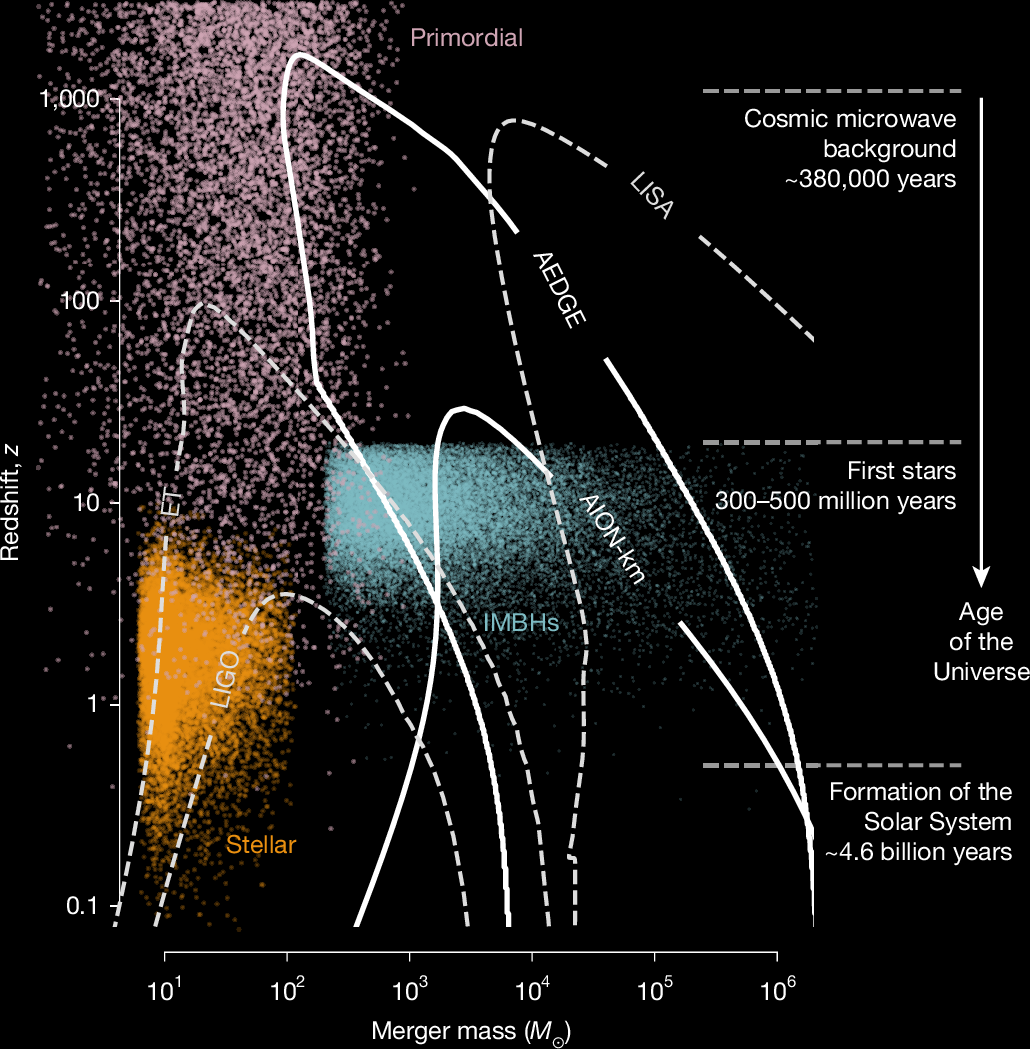
Abstract
Gravitational waves and ultralight dark matter are among the most compelling frontiers in fundamental physics, motivating proposals for very-long-baseline atom interferometerssuch as AION1, MAGIS2, AICE3 and AEDGE4 that aim to detect at frequencies at which ground-based5 and space-borne6 laser interferometers lose sensitivity. Very-long-baseline atom interferometers look for signals by comparing the quantum phase evolution of widely separated atomic ensembles interrogated by a common laser. However, their performance depends critically on suppressing noise sources, particularly laser phase noise. The experimental validation of such noise rejection remains an important challenge. Here we demonstrate a prototype differential atom interferometer based on the single-photon clock transition of fermionic 87Sr. Thus, we obtain a gradiometer configuration with a species intrinsically suited to kilometre-scale and space-baseline operation. The instrument operates at the standard quantum limit7 with no excess noise beyond atom shot noise. The differential configuration maintains quantum-limited sensitivity in the presence of several radians of artificially injected laser phase noise per shot, which emulates the conditions expected in a very-long-baseline atom interferometer. We also demonstrate the recovery of coherent oscillatory signals across a broad frequency range under fully phase-randomized conditions, a capability that is inaccessible to a single interferometer operating in the same regime. These results provide an experimental validation of the noise-immune measurement principle underlying very-long-baseline atom interferometers and mark an important step towards next-generation quantum sensors for gravitational-wave detection and searches for ultralight dark matter8,9.