2026-06-16 フランス国立科学研究センター(CNRS)
<関連情報>
- https://www.cnrs.fr/en/press/intensive-nickel-mining-has-transformed-microbial-biodiversity-thio-lagoon-new-caledonia
- https://www.nature.com/articles/s43247-026-03677-8
数十年にわたる無規制の陸上採掘によって引き起こされた沿岸生態系の劣化 Coastal ecosystem degradation driven by decades of unregulated terrestrial mining
Mathisse Meyneng,Hugues Lemonnier,Dominique Ansquer,Florence Antypas,Nicolas Briant,Delphine Dissard,Axel Ehrhold,Thomas Haize,Gwenaël Jouet,Farid Juillot,Clémence Lavignon,Vladimir Mikryukov,Arthur Monjot,Pascal Le Roy,Sabine Schmidt,Leho Tedersoo &Raffaele Siano
Nature Earth & Environment Published:16 June 2026
DOI:https://doi.org/10.1038/s43247-026-03677-8
Abstract
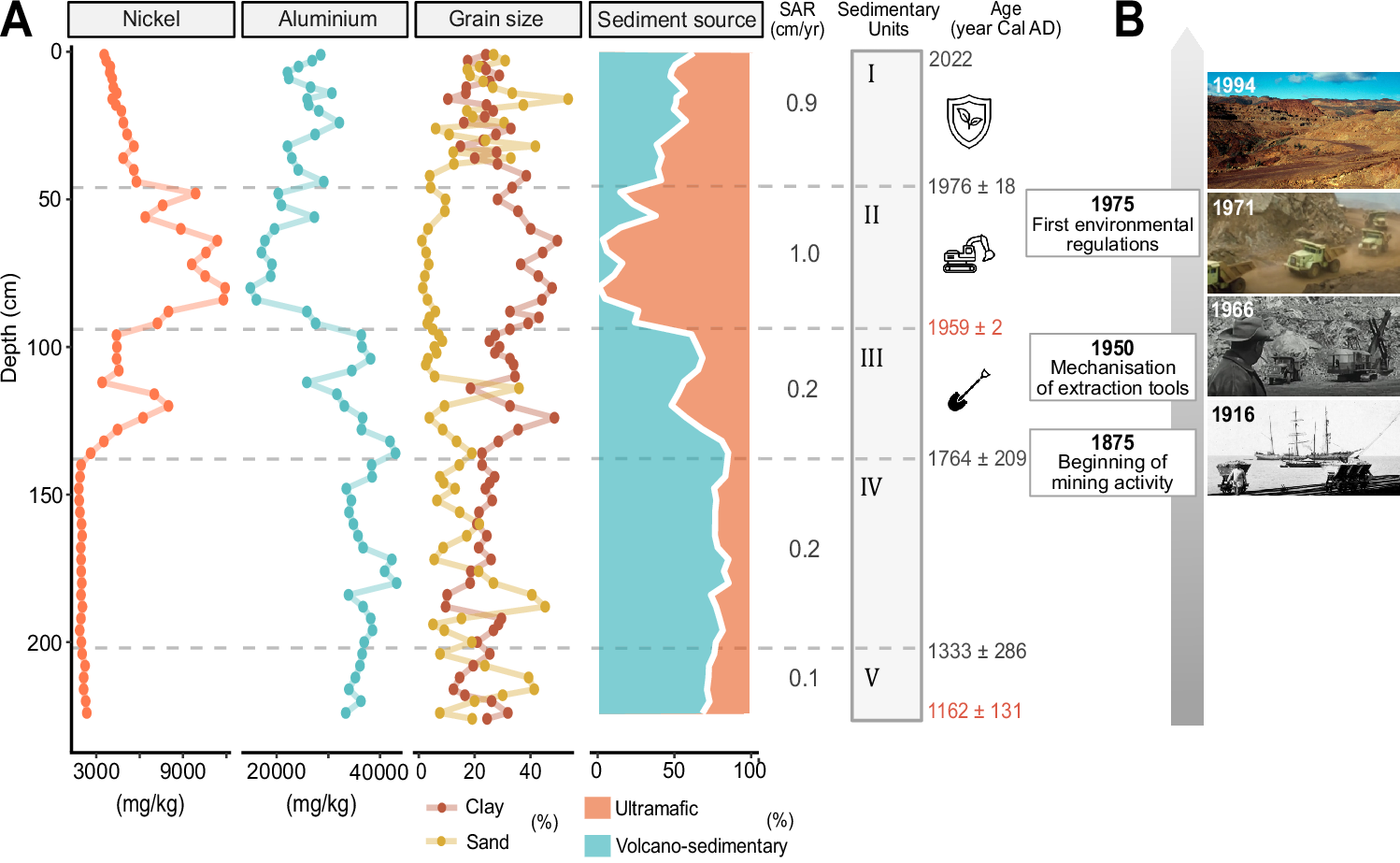
Anthropogenic land-based disturbances can cascade into the sea, altering coastal ecosystems over long timescales. Mining exemplifies this land-sea connectivity, yet its full environmental footprint is underestimated when marine impacts are overlooked. Here, we investigate long-term coastal changes associated with nickel mining using a paleoecological approach in New Caledonia. A 226-cm sediment core spanning ~1000 years was analysed, combining ancient sedimentary DNA, foraminifera, and geochemistry. Since its onset in 1875, mining has modified sediment run-off and microbial assemblages. The most pronounced changes occurred in the 1960s after the mechanisation of extraction tools, which intensified soil erosion and increased sediment run-off, altering the richness and structure of both microeukaryotic and foraminiferal communities. Although post-1975 regulations mitigated nickel-rich run-off, persistent ecological disturbances remain. These findings highlight how terrestrial disturbances can induce long-term changes in coastal ecosystems, emphasising that land and sea should be studied and managed as a connected continuum.