
2026-06-10 ジョージア工科大学(Georgia Tech)
<関連情報>
- https://research.gatech.edu/georgia-tech-scientists-create-moon-rock-lab
- https://iopscience.iop.org/article/10.3847/PSJ/ae6074
合成太陽風を用いたイルメナイトにおける月面のような縁の形成 Creation of Lunar-like Rims in Ilmenite Using Synthetic Solar Wind
Roshan S. Trivedi, Advik D. Vira, Brant M. Jones, Katherine D. Burgess, Ziyu Huang, Honglin Liu, Pranav Rane, Mengkun Tian, Masatoshi Hirabayashi, Thomas M. Orlando,…
The Planetary Science Journal Published: 2026 June 10
DOI:10.3847/PSJ/ae6074
Abstract
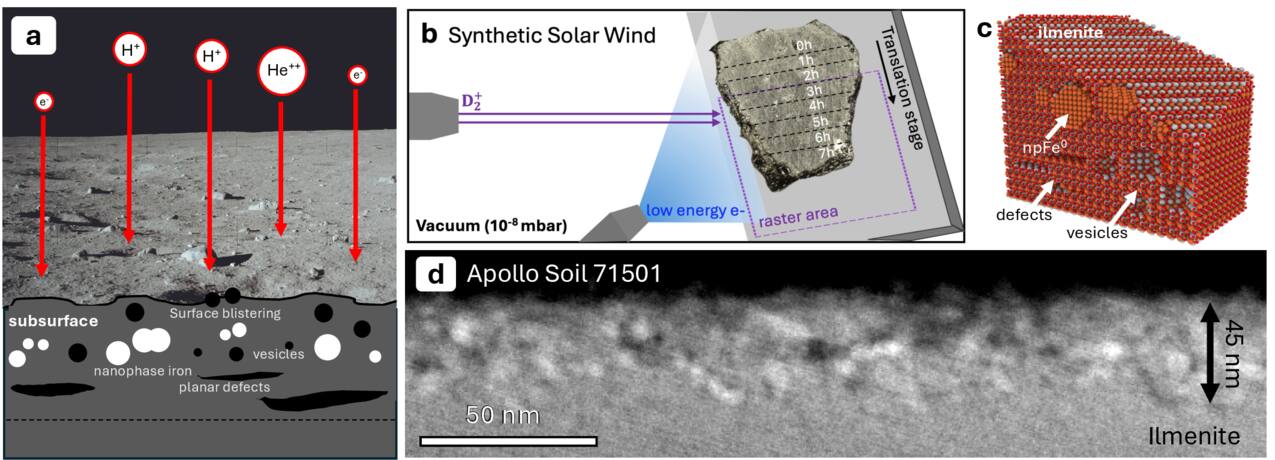
Space weathering of lunar minerals, due to bombardment from solar wind (SW) particles and micrometeoroid impacts, modifies the mineralogy within tens of nanometers of the surface, i.e., the rim. Spectroscopic signatures of these modifications, observed via remote sensing, have long been used to gauge surface exposure times on the Moon. However, the relative contributions of SW and micrometeoroids in the creation of rim features are still debated, particularly for the nanometer-scale clusters known as nanophase iron (npFe0), which commonly form in ferrous minerals. We address this issue in the laboratory, using deuterium ions and low-energy electrons as a synthetic solar wind plasma to irradiate ilmenite (FeTiO3), a common lunar mineral. Characterization by high-resolution scanning transmission electron microscopy and electron energy-loss spectroscopy shows that the SW alone creates rims with all the main characteristics of lunar samples. We conclusively identify npFe0 and quantify its distribution as a function of depth and fluence, allowing us to estimate the SW exposure of Apollo soil 71501. Our results confirm that small npFe0 particles (<10 nm in diameter) form from SW irradiation. Such experiments provide microscopic details of space weathering, improving the link between surface modification processes and macroscopic remote-sensing data.

