2026-03-03 農業・食品産業技術総合研究機構
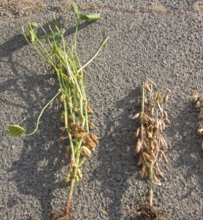
青立ち株(左)と正常な株(右)
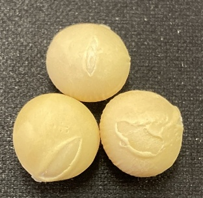
裂皮粒
<関連情報>
- https://www.naro.go.jp/publicity_report/press/laboratory/niaes/174747.html
- https://www.sciencedirect.com/science/article/abs/pii/S1161030125002667
気候変動下における大豆の障害を予測し、適応策を評価するための機械学習アプローチ Machine learning approaches for predicting soybean disorders under climate change and assessing adaptation measures
Etsushi Kumagai, Takahiro Takimoto, Ai Hishinuma, Yoshitake Takada, Nobuhiko Oki, Ryo Yamazaki
European Journal of Agronomy Available online: 22 July 2025
DOI:https://doi.org/10.1016/j.eja.2025.127770
Highlights
- RF regression predicted GSD, SCC, and SCW scores with moderate accuracy.
- Reproductive stage temperature was a key predictor of GSD and SCC scores.
- Cultivar-specific traits were linked to SCW score.
- Future climate projections indicated increased risks for GSD and SCC occurrences.
- Late sowing and late-maturing cultivars may reduce risks in the future.
Abstract
Soybean production in Japan is increasingly affected by climate change, with rising temperatures and changing soil moisture conditions contributing to green stem disorder (GSD), seed coat cracking (SCC), and seed coat wrinkling (SCW). These disorders reduce seed yield, lower seed quality, and complicate harvesting. To better understand and predict their occurrence (score), we developed random forest (RF) regression models using historical cultivar data and environmental factors from four major soybean breeding sites in Japan. The RF models outperformed traditional regression methods, achieving moderate prediction accuracy for GSD, SCC, and SCW scores (R² > 0.5). Analysis of the partial dependence plot suggested that increased GSD and SCC scores were associated with high temperatures during reproductive stages, while the SCW score showed a stronger link to cultivar traits. Future projections, derived from predictive models and future climate scenarios, suggested that GSD and SCC scores could increase at all sites, whereas the SCW score might rise at specific sites. Adaptation strategies such as late sowing and use of late-maturing cultivars showed potential for reducing risks, but their effectiveness varied by site and disorder type. These findings underscore the importance of considering region-specific strategies to address climate-related challenges in soybean production. By integrating machine learning with historical cultivar data, this study offers insights into developing targeted adaptation measures that could support sustainable soybean cultivation in a changing climate.