2026-06-10 京都⼤学
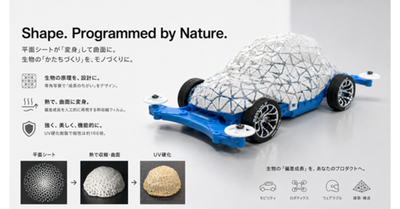
フィルムの場所ごとに収縮率が異なる「偏差成長」を実装 こちらは実験結果の写真(造形・撮影:森川健太郎)を素材とした生成AI画像(ChatGPT Images 2.0)です(作成:井上康博)
<関連情報>
- https://www.t.kyoto-u.ac.jp/ja/research/topics/20260610
- https://royalsocietypublishing.org/rsif/article/23/239/20251094/482053/Artificial-morphogenesis-of-curved-surface
生物の偏差成長に着想を得た曲面構造の人工形態形成 Artificial morphogenesis of curved surface structures inspired by differential growth in biology
Kentaro Morikawa ;Takumi Nakamura;Yoshihiko Matsumoto;Keisuke Matsuda;Masakazu Akiyama;Shintaro Yamasaki;Shigeru Kondo;Yasuhiro Inoue
Journal of the Royal Society Interface
DOI:https://doi.org/10.1098/rsif.2025.1094
Abstract
From the elegant petals of flowers to advanced aerospace designs, curved surfaces are fundamental to both natural and engineered systems, playing critical roles in structural and functional performance. In biology, these surfaces frequently arise from differential growth processes, where spatially varying growth rates orchestrate the transformation of flat tissues into intricate three-dimensional forms, exemplified by leaf curling or organ development. Engineering such surfaces, however, remains challenging, as current methods are energy-intensive, material-heavy, and lack the efficiency and adaptability seen in natural systems. Here, we demonstrate an artificial morphogenesis methodology that fabricates curved surfaces from planar materials by programming area change rates calculated through conformal mapping. Using heat-shrink film, we three-dimensionally-printed precisely patterned non-shrinking elements to implement calculated area change rate distributions, ensuring precision and reproducibility. This method enables the design and production of diverse target shapes using adaptable materials that maintain their shape even in dry environments. Compared with conventional techniques, this approach reduces material waste, eliminates the need for moulds and offers high adaptability. This bioinspired framework bridges biological principles with modern fabrication techniques, advancing curved surface design. Potential applications include adaptive medical implants for minimally invasive surgeries, lightweight aerospace structures and soft robotic skins with real-time adaptability.