2026-06-05 国立天文台
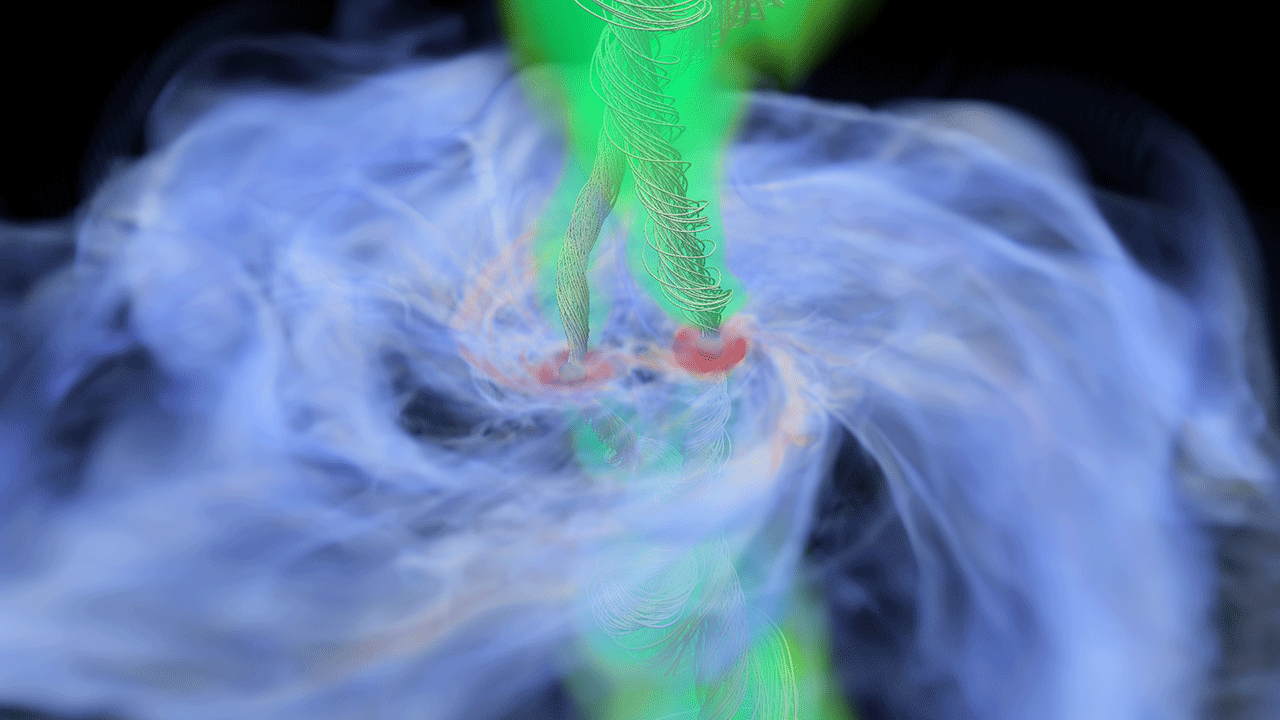
「アテルイIII」によって計算された連星周囲のガスの様子。青で示したガスは周連星円盤(連星を取り囲む円盤)、赤で示したガスは星周円盤(各々の星を取り囲む円盤)を表す。2個の濃い灰色の球は連星の位置を表す。星から垂直に伸びる緑色の二対の構造は星から放出されるガス(アウトフローまたはジェットと呼ぶ)を表す。アウトフローの芯に磁力線を表示している(クレジット:Matsumoto, Hotokezaka, Inayoshi 2026)
<関連情報>
- https://www.nao.ac.jp/news/science/2026/20260605-cfca.html
- https://academic.oup.com/mnras/article/548/2/stag669/8651299
磁場によって誘発される連星系と周連星円盤の合体:ブラックホールと原始星系 Magnetic-field-induced inspiral of binaries with circumbinary disc: black hole and protostellar systems
Tomoaki Matsumoto ,Kenta Hotokezaka ,Kohei Inayoshi
Monthly Notices of the Royal Astronomical Society Published:10 April 2026
DOI:https://doi.org/10.1093/mnras/stag669
ABSTRACT
The orbital decay of binary systems is a critical process for understanding the evolution of massive binary black holes (MBBHs) and binary star formation. Performing high-resolution three-dimensional magnetohydrodynamic simulations, we investigate a binary system that accretes gas from an infalling envelope analogous to the collapse of molecular cloud cores in the context of binary star formation. Our simulations reveal the presence of outflows/jets launched from both the circumstellar (mini) discs and the circumbinary disc (CBD). The magneto-rotational instability is also excited within the CBD. These magnetic processes efficiently transport angular momentum in the gas surrounding the binary and thereby drive orbital decay, while a purely hydrodynamical model exhibits orbital expansion. The decay rate reaches ~0.3-0.7 per cent per orbital period, depending on the initial magnetic field strength. By appropriately scaling these numerical results, we propose a new mechanism for MBBH mergers within a Hubble time, overcoming the bottlenecks encountered at separations near the final parsec scales. Additionally, we present a formation scenario for close twin binary star systems, emphasizing the significant role of magnetic processes in driving orbital evolution across various astrophysical systems.