2026-05-29 合肥物質科学研究院(HFIPS)
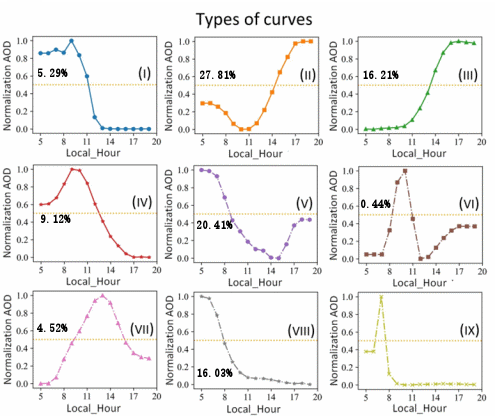
Nine Typical Diurnal Variation Characteristic Curves of Aerosol Optical Depth (AOD) at Global AERONET Stations (Category 9 only represents cases with excessive missing values or outliers in the diurnal variation data) (Image by CHEN Cheng)
<関連情報>
- https://english.hf.cas.cn/nr/rn/202605/t20260529_1160078.html
- https://agupubs.onlinelibrary.wiley.com/doi/10.1029/2025GL120933
AERONETによる32年間の観測から得られた、エアロゾル光学的厚さの地球規模の日変化特性 Global Diurnal Variation Characteristics of Aerosol Optical Depth From 32 Years of AERONET Observations
Yujia Cao, Cheng Chen, Donghui Li, Siyao Zhai, Yan Wang, Zhihui Wang, Ke Xiao, Haixiao Yu
Geophysical Research Letters Published: 15 April 2026
DOI:https://doi.org/10.1029/2025GL120933
Abstract
Aerosols are ubiquitous microscopic particles in the atmosphere, and their diurnal variation characteristics reflect short-term atmospheric changes that are crucial for climate monitoring and prediction. However, satellite, ground-based, and reanalysis systems cannot simultaneously provide observational authenticity together with full temporal–spatial continuity. Using 32 years of hourly ground-truth Aerosol Optical Depth (AOD) data from the global AERONET network, we identify eight representative modes of AOD diurnal variability through cluster analysis. The dominant diurnal patterns are strongly influenced by land cover and aerosol type. Comparison with MERRA-2 reanalysis shows that only 12.7% of stations exhibit consistent all-day diurnal AOD variability with AERONET observations. These results provide new constraints for understanding global aerosol diurnal behavior and offer guidance for satellite temporal sampling strategies and the improvement of satellite-based AOD retrievals.
Plain Language Summary
Aerosols are tiny particles in the atmosphere that influence Earth’s radiation balance and energy exchange within the climate system. Understanding how aerosol levels change throughout the day is important for improving climate monitoring and satellite observations. In this study, we analyzed 32 years of hourly aerosol optical depth measurements from the worldwide AERONET ground-based network. Using a clustering method, we identified eight representative patterns that describe typically daily changes in aerosol levels. These patterns vary across different land surface types and aerosol environments. Comparisons with the MERRA-2 reanalysis show that agreement with AERONET observations occurs mainly in the morning over natural surfaces and in the afternoon over anthropogenic regions. These results help explain global differences in aerosol daily variability and provide guidance for improving the temporal sampling and interpretation of satellite aerosol observations.