2026-05-27 北海道大学,工学院大学,高輝度光科学研究センター,佐賀県立九州シンクロトロン光研究センター,近畿大学
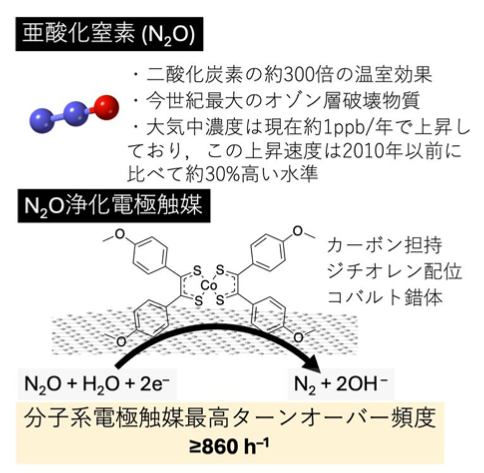
図1. N2Oの特徴と本研究で開発した電極触媒による電気化学N2O浄化
<関連情報>
- https://www.hokudai.ac.jp/news/2026/05/post-2299.html
- https://www.hokudai.ac.jp/news/pdf/260527_pr2.pdf
- https://pubs.acs.org/doi/10.1021/jacs.6c03398
カーボン担持ビスジチオレン配位金属錯体により触媒される水中での電極触媒的亜酸化窒素還元 Electrocatalytic N2O Reduction Catalyzed by Carbon-Supported Metal–Bis(diaryldithiolene) Complexes in Water
Masaru Kato,Naoto Kuwamura,Zhengwei Ma,Haruto Tsukamoto,Ken Tokunaga,Taichi Kobayashi,Takeshi Watanabe,Hiroyuki Setoyama,Hiroyuki Asakura,Kenji Ishii,and Ichizo Yagi
Journal of the American Chemical Society Published: May 3, 2026
DOI:https://doi.org/10.1021/jacs.6c03398
Abstract
We report the electrocatalytic nitrous oxide reduction reaction (N2ORR) activity of iron, cobalt, and nickel complexes with a noninnocent ligand of diaryldithiolene in alkaline media. At −0.3 V vs RHE, the cobalt complex on a carbon black of Ketjenblack (CoL2/KB) showed the highest N2ORR activity with a turnover frequency (TOF) of (3.6 ± 0.5) × 102 h–1, 98% Faradaic efficiency to N2 and almost no degradation over 24 h. At −0.6 V vs RHE, CoL2/KB exhibited a TOF of (8.6 ± 1.1) × 102 h–1, surpassing those of previously reported molecular-based electrocatalysts for the N2ORR. X-ray absorption spectroscopy and density functional theory calculations revealed that the square-planar CoI–S4 coordination environment with high Co–S covalency serves as the active site with high N2ORR activity. This work will guide us in designing and developing precious metal-free electrocatalysts with high N2ORR activity.