2026-05-21 琉球大学
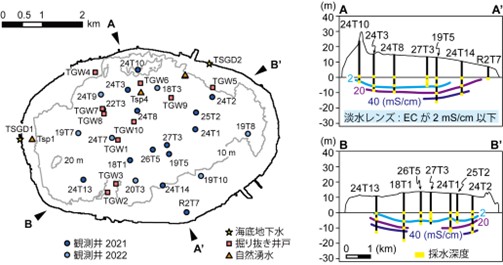
図1 多良間島における採水地点および淡水レンズの賦存状況
<関連情報>
- https://www.u-ryukyu.ac.jp/news/78312/
- https://www.sciencedirect.com/science/article/abs/pii/S0043135426004240
同位体トレーサーと物質収支計算に基づく石灰岩島の淡水・海水界面における脱窒速度の定量的評価 Quantitative assessment of denitrification rates at the freshwater-saltwater interface of a limestone island based on isotopic tracers and mass balance calculation
Takahiro Hosono, Takatomo Ikehara, Jun Yasumoto, Yasuyuki Ueji, Ko Yasumoto, Ryogo Takada, Hiroki Yamamoto, Adina Paytan, Ryuichi Shinjo
Water Research Available online: 12 March 2026
DOI:https://doi.org/10.1016/j.watres.2026.125742
Highlights
- Natural capacity for groundwater nitrate removal was quantified on whole-island-scale.
- Isotope ratios were used to identify the cause of nitrate pollution and attenuation.
- Three-dimensional distribution of denitrification in the freshwater lens was mapped.
- Denitrification removal rate was estimated based on water and nitrogen mass balance.
- One third of the nitrogen loaded returns to the atmosphere through denitrification.
Abstract
Surface nitrogen loads are causing groundwater contamination and surface water eutrophication. Given the global occurrence of nitrogen pollution, shedding light on nitrogen sources and transformations within diverse watersheds worldwide is important. However, studies that assess denitrification rates at the saltwater-freshwater interface are seldom based on field observation on watershed scales. This issue remains a significant challenge for evaluating the global nitrogen transport from land to the coastal ocean via groundwater. Here we quantitatively estimated the denitrification capacity at the saltwater-freshwater interface within limestone aquifers utilizing a dense observation network and included socio-economic statistics related to nitrogen infiltration rates across an entire island. We first mapped the three-dimensional distribution of denitrification in the freshwater lens, including the saltwater-freshwater interface, based on multiple isotope data (δ13C, δ15N and δ34S). Then, based on a simplified water and nitrogen mass balance, we estimate the annual denitrification removal rate relative to the island’s total nitrogen loads. We demonstrated that approximately one third of the nitrogen loaded on the flat limestone Tarama Island, Japan is returned to the atmosphere through denitrification. The results of this study provide valuable insights into water conservation in limestone island regions and offer important guidelines for constructing broader nitrogen dynamics models in the future.