2026-05-12 中国科学院(CAS)
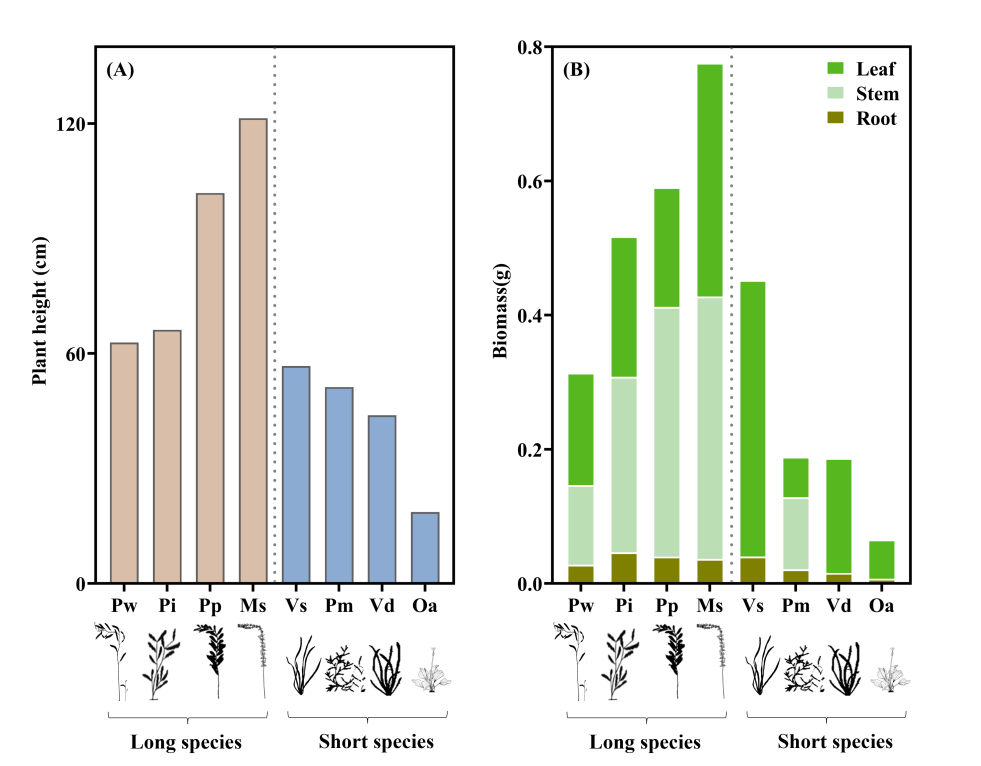
Plant height and biomass allocation characteristics of long and short species (Image by WBG)
<関連情報>
- https://english.cas.cn/newsroom/research-news/202605/t20260512_1159235.shtml
- https://www.sciencedirect.com/science/article/abs/pii/S0301479726009643
富栄養湖における水生植物の回復を最適化する:植物群落構造と水深からの知見 Optimizing submerged plant restoration in eutrophic lakes: Insights from plant community structure and water depth
Manli Xia, Wei Li, Yongwei Zhi, Yu Cao
Journal of Environmental Management Available online: 28 March 2026
DOI:https://doi.org/10.1016/j.jenvman.2026.129504
Highlights
- Canopy-forming communities inhibited subsequent plant growth, and this inhibition was exacerbated by water depth.
- Rosette-forming communities buffered the differential effects of water depth on plants.
- Rosette-forming communities were conducive to subsequent plant restoration.
- Plant height-based functional classification exhibits predictive validity.
- Long species showed growth advantages over short species, but this pattern was environmentally dependent.
Abstract
Subtropical shallow lakes often experience monospecific succession of submerged macrophytes, resulting in two typical community structures: canopy-forming (associated with eutrophic stages) and rosette-forming (associated with post-restoration conditions). However, current understanding of how these two community structures influence subsequent plant colonization remains limited. This study employed a mesocosm experiment with different plant community structures (PCSs): canopy-forming communities (CAs), rosette-forming communities (ROs), and no-plant controls (CK), combined with two water depths, to examine the effects of PCSs on the growth of eight submerged macrophyte species. Based on the key functional trait—plant height, these eight typical species were classified into two growth forms: long species and short species, with a focus on elucidating consistent patterns of plant responses under the combined effects of PCSs and water depth. The results showed that: (i) The effects of PCSs on plant growth varied and were modulated by water depth: CAs inhibited subsequent plant colonization through intense competition for light resources, with this inhibitory effect intensifying with increasing water depth; ROs homogenized underwater environmental heterogeneity, effectively alleviating deep-water stress, reducing plant biomass differences induced by water depth treatment, and weakening competitive imbalance between long and short species. (ii) Functional classification based on plant height effectively predicted species responses: long species exhibited between performance in shallow water, or under the background of CAs, and CK, but these advantages were context-dependent, significantly diminishing or disappearing in deep water and under the background of ROs. Notably, Potamogeton maackianus, despite morphological similarity to long species, displayed response patterns characteristic of short species, highlighting the importance of ecological functional classification. This study demonstrated that PCSs regulated subsequent species colonization through microenvironmental filtering and that plant height could serve as a key functional indicator for predicting coexistence patterns among submerged macrophytes. Our findings provide experimental evidence for community assembly of submerged macrophytes, and this knowledge can be used in natural lake restoration to improve the plant diversity.