2026-05-11 中国科学院(CAS)
中国科学技術大学の研究チームは、次世代通信技術である「量子インターネット」の実現に向け、新しい量子中継システム「Xinghan-2」を開発した。量子通信では、情報を運ぶ光子が長距離伝送中に失われやすいため、途中で信号をつなぐ「量子中継」が必要となる。しかし従来技術では、「通信速度を高める」と「情報の正確さ(忠実度)を保つ」の両立が難しかった。
今回の研究では、光子を同時に到着させる代わりに、到着時間をずらして一時保存できる「多モード量子メモリ」を利用した。これにより、通信効率が大幅に向上し、14.5 km離れた地点間で高品質な量子もつれ状態の生成に成功した。さらに、既存の光ファイバー回線を利用しながら、従来の都市型量子通信システムより100倍以上高速な量子もつれ分配を達成した。
この成果は、将来的に超高速かつ盗聴が極めて困難な量子インターネットや量子暗号通信を実現するための重要な技術基盤になると期待されている。
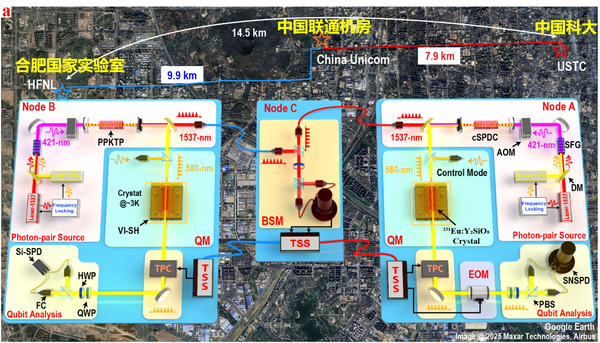
Schematic diagram of Xinghan-2, a multi-mode quantum relay network. (Photo courtesy of the University of Science and Technology of China)
<関連情報>
- https://english.cas.cn/newsroom/cas-in-media/202605/t20260511_1159118.shtml
- https://www.nature.com/articles/s41566-026-01911-5
ベル非局所性を備えた都市規模の多重化量子リピーター A metropolitan-scale multiplexed quantum repeater with Bell non-locality
Tian-Xiang Zhu,Chao Zhang,Zhong-Wen Ou,Xiao Liu,Peng-Jun Liang,Xiao-Min Hu,Yun-Feng Huang,Zong-Quan Zhou,Chuan-Feng Li & Guang-Can Guo
Nature Photonics Published:07 May 2026
DOI:https://doi.org/10.1038/s41566-026-01911-5
Abstract
Quantum repeaters can overcome exponential photon loss in optical fibres, enabling heralded entanglement between distant quantum memories. The definitive benchmark for this entanglement is Bell non-locality; however, recent metropolitan-scale demonstrations based on single-photon interference schemes have been limited to generating low-quality entanglement, falling short of Bell non-locality certification. Here we introduce a multiplexed quantum repeater protocol based on time measurements, successfully combining the high heralding rate of single-photon interference schemes with the phase robustness of two-photon interference schemes. This approach achieves heralded entanglement distribution between two solid-state quantum memories over a record 14.5-km separation, generating a Bell state with a fidelity of 78.6% ± 2.0%. We observe a Clauser–Horne–Shimony–Holt–Bell inequality violation by 3.7 standard deviations, marking the first certification of Bell non-locality in metropolitan-scale quantum repeaters. Our architecture supports autonomous quantum node operation without fibre channel phase stabilization, offering a practical framework for scalable quantum repeater networks.