2026-04-22 東京科学大学
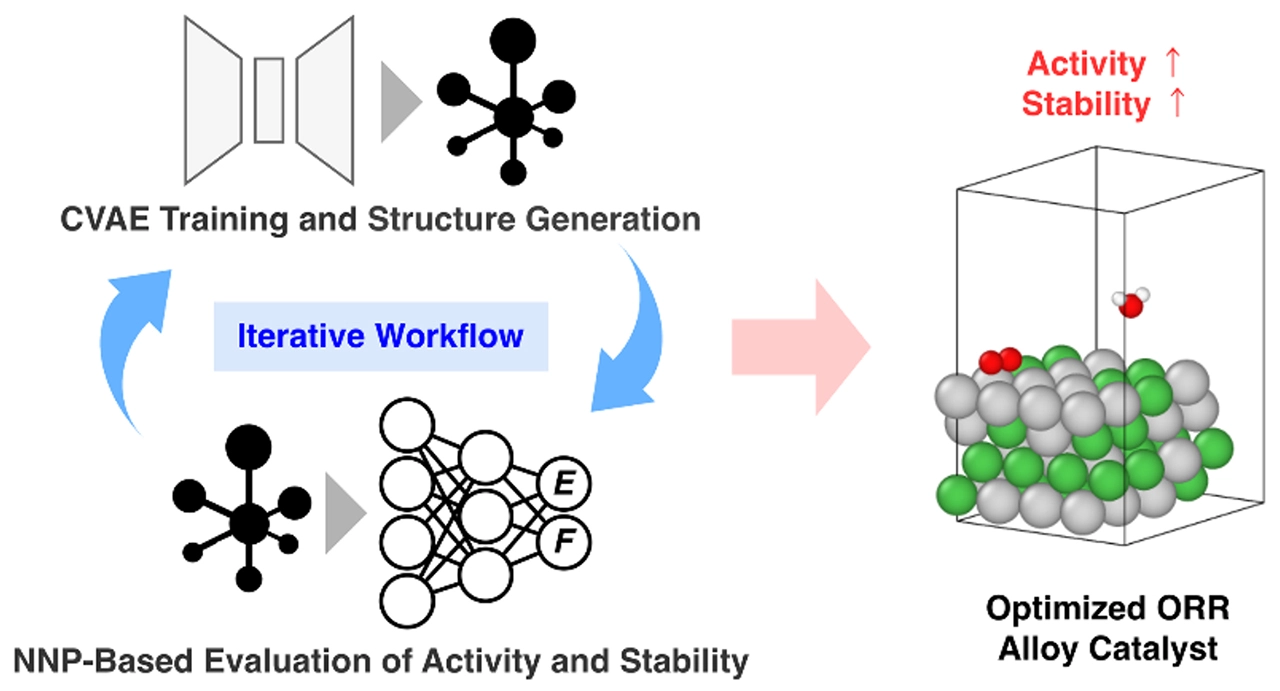
図1. 本研究で提案する、原子スケール計算による活性・安定性予測と生成モデルによるORR触媒生成のワークフロー
<関連情報>
条件付き変分オートエンコーダと原子論的計算を用いた酸素還元反応のための人工触媒生成 Artificial catalyst generation for the oxygen reduction reaction using conditional variational autoencoder and atomistic calculations
Taishiro Wakamiya & Atsushi Ishikawa
npj Computational Materials Published:14 April 2026
DOI:https://doi.org/10.1038/s41524-026-02075-0 Unedited version
Abstract
We developed a method that generates catalyst structures for the oxygen reduction reaction (ORR) by combining atomistic-scale calculations with a conditional variational autoencoder (CVAE). The CVAE was trained with overpotential (η) and alloy formation energy (Eform) as conditional labels and used to generate new structures. The neural-network potential (NNP) was used to evaluate η and Eform for the generated materials. This CVAE-generation and NNP-evaluation procedure enables iterative improvement of the dataset, as data for generated samples can be added to the previous dataset. We applied this method to Pt–Ni alloys. Across six iterations (128 initial and 128 added per iteration), the distributions shifted toward lower η and more negative Eform. The mean value of the dataset was varied from η = 1.126 to 0.520 V and from Eform = −0.027 to −0.047 eV/atom. This result demonstrates that both the activity and stability were improved simultaneously. Latent-space analysis revealed that the CVAE explored areas of the data space not present in the initial data, creating Pt-rich surface structures consistent with previously known ORR design principles. This method accelerates inverse design of alloy catalysts and provides a general approach for discovering structures that jointly satisfy high activity and thermodynamic stability.