
2026-04-14 米国国立再生可能エネルギー研究所(NREL)
<関連情報>
- https://www.nlr.gov/news/detail/program/2026/ai-guided-electron-microscope-provides-unique-glimpse-into-the-world-of-mxenes
- https://www.nature.com/articles/s41467-026-71670-y
二次元MXeneにおける点欠陥の隠された第三次元を明らかにする Revealing the hidden third dimension of point defects in two-dimensional MXenesGrace
Guinan,Michelle A. Smeaton,Brian C. Wyatt,Steven Goldy,Hilary Egan,Andrew Glaws,Garritt J. Tucker,Babak Anasori & Steven R. Spurgeon
Nature Communications Published:14 April 2026
DOI:https://doi.org/10.1038/s41467-026-71670-y
Abstract
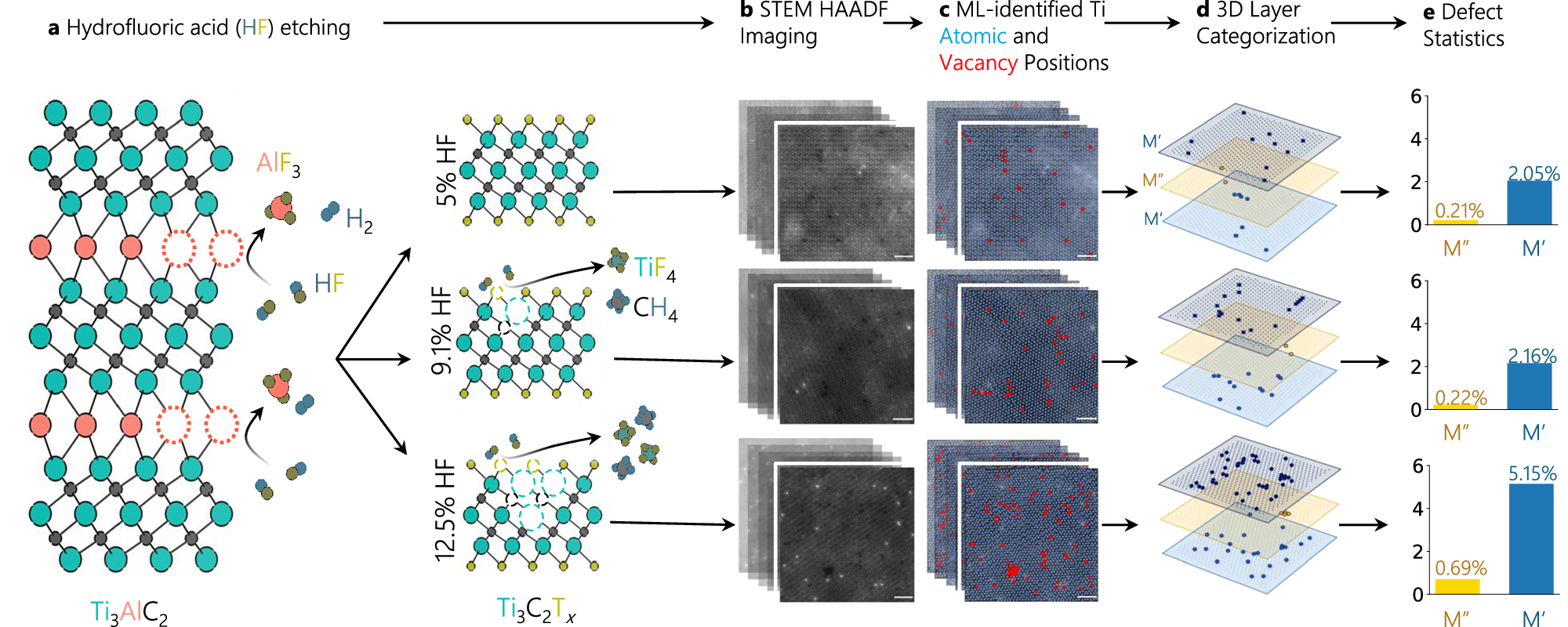
Point defects govern many important functional properties of two-dimensional (2D) materials. However, resolving the three-dimensional (3D) arrangement of these defects in multi-layer 2D materials remains a fundamental challenge, hindering rational defect engineering. Here, we overcome this limitation using an artificial intelligence-guided electron microscopy workflow to map the 3D topology and clustering of atomic vacancies in Ti3C2TX MXene. Our approach reconstructs the 3D coordinates of vacancies across hundreds of thousands of lattice sites, generating robust statistical insight into their distribution that can be correlated with specific synthesis pathways. This large-scale data enables us to classify a hierarchy of defect structures—from isolated vacancies to nanopores—revealing their preferred formation and interaction mechanisms, as corroborated by molecular dynamics simulations. This work provides a generalizable framework for understanding and ultimately controlling point defects across large volumes, paving the way for the rational design of defect-engineered functional 2D materials.

