2026-04-08 国立天文台
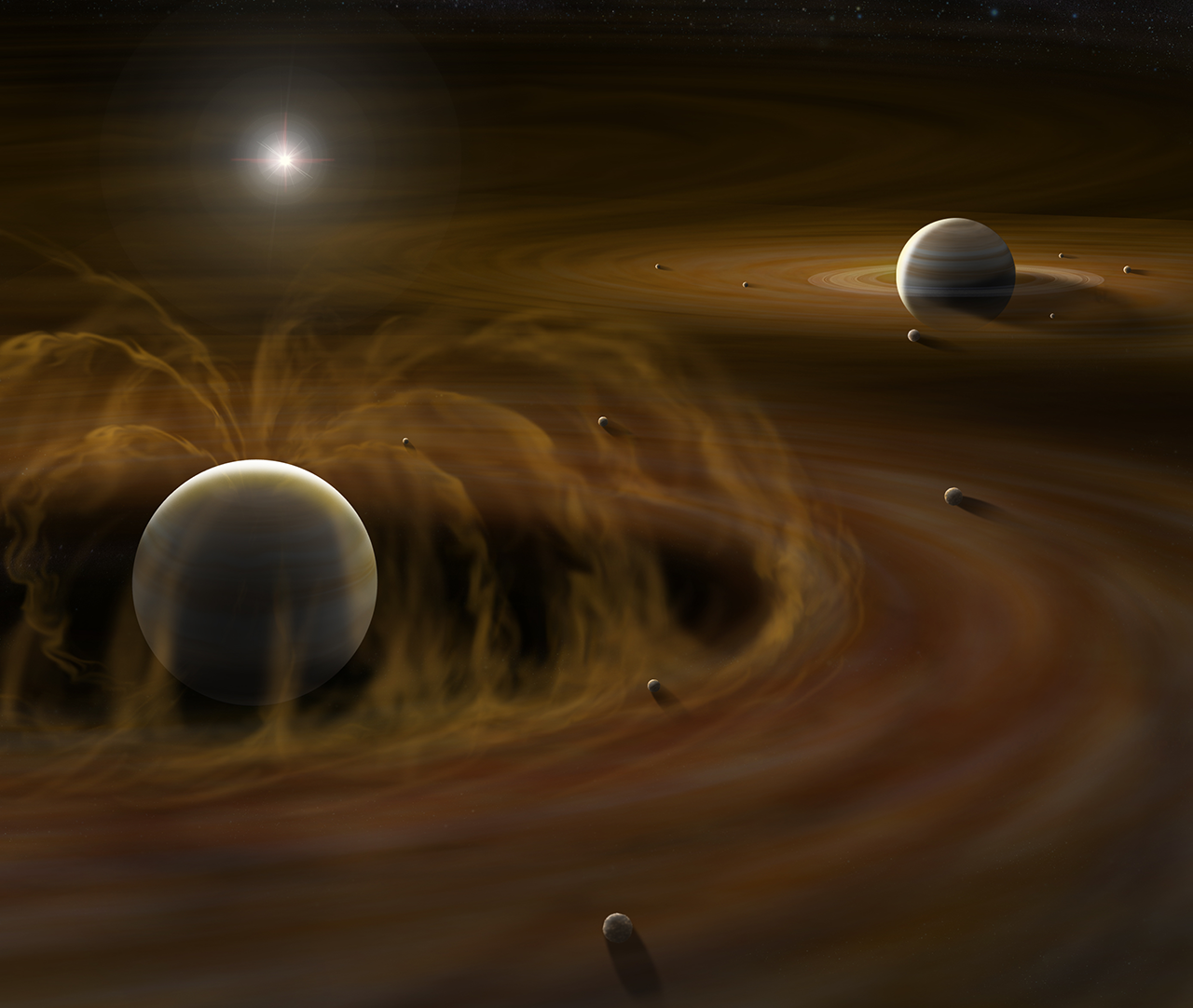
ガス惑星の周りの円盤で、衛星が形成される様子のイメージ。木星(左手前)には磁場に沿ってガスが流れ込んでいる。土星(右奥)には、赤道面からガスが流れ込んでいる。この時期の土星には環(わ)はまだ存在しないが、木星と区別しやすくするために、この図では環を描いている。左奥は生まれたばかりの太陽。(クレジット:藤井悠里(L-INSIGHT/京都大学)、木下真一郎
<関連情報>
- https://www.nao.ac.jp/news/science/2026/20260408-cfca.html
- https://www.cfca.nao.ac.jp/pr/20260408
- https://www.nature.com/articles/s41550-026-02820-x
木星と土星の衛星系の構造は、磁気圏空洞の形成によって異なる Different architecture of Jupiter and Saturn satellite systems from magnetospheric cavity formation
Yuri I. Fujii,Masahiro Ogihara & Yasunori Hori
Nature Astronomy Published:02 April 2026
DOI:https://doi.org/10.1038/s41550-026-02820-x
Abstract
The Jovian system has four large moons, three of which are in the Laplace resonance, whereas the Saturnian system is dominated by one giant moon. What creates the difference is still a mystery. Here we show that the formation of a magnetospheric cavity in the circumplanetary disk around a young gas giant can explain the different orbital configurations of these two satellite systems. The strong surface magnetic field of Jupiter carves a cavity while the ionization degree of the disk gas remains high enough for magnetic coupling. By contrast, Saturn has too weak a surface magnetic field to open a cavity due to the narrow dynamo layer in its deep interior. Our N-body simulations show that Laplace resonance can form near the cavity and survive until the disk dissipates, but protosatellites in the circum-Saturnian disk fall onto the planet and only Titan, formed at a wide orbit, survives with the help of a ‘safety zone’. Our findings predict that compact exomoon systems, in cases of massive gas giants, and a couple of distant moons, in cases of Saturn-sized gas giants, will be found in future surveys.