2026-01-22 アメリカ合衆国・ロチェスター大学
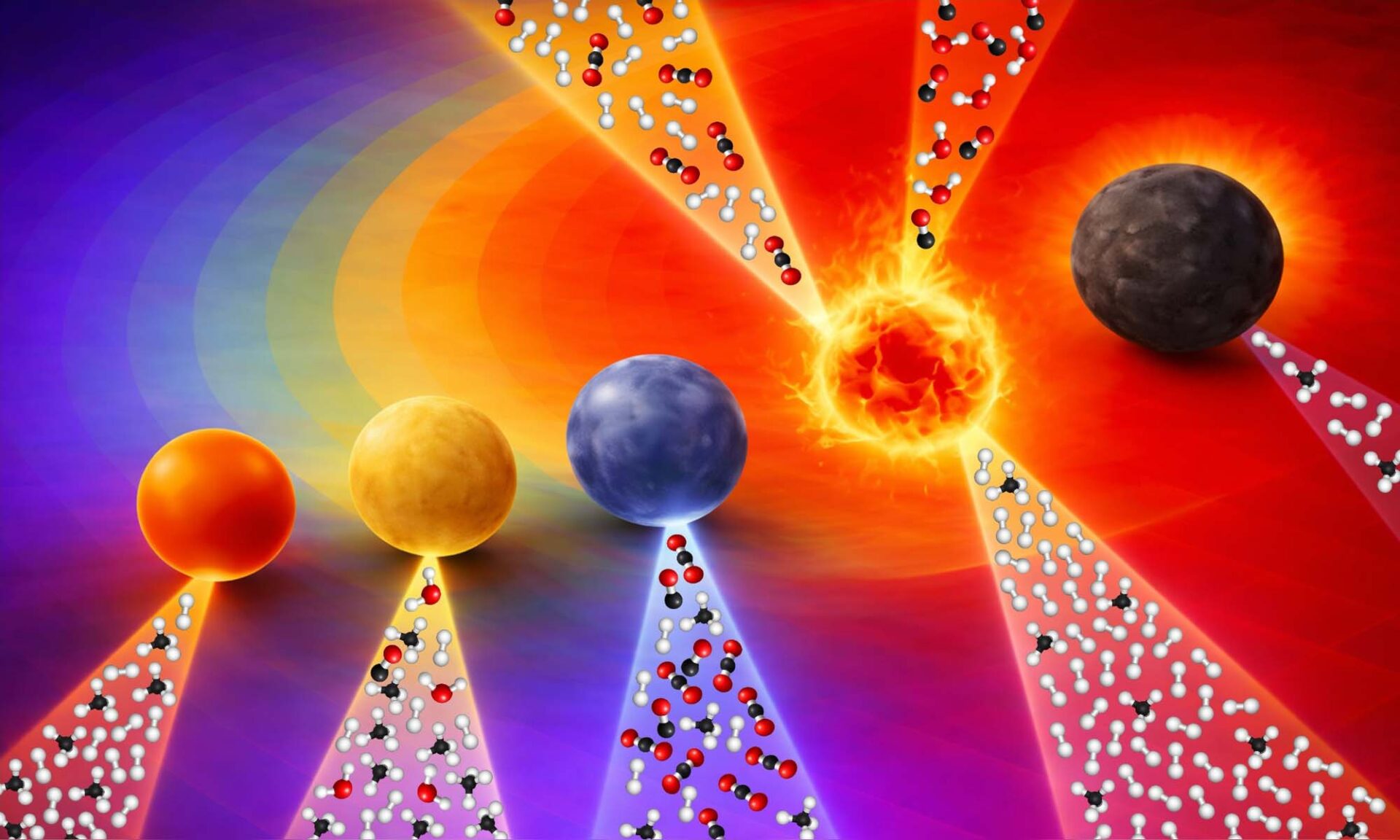
SLIP OF THE TUNGSTEN: The evolution of carburization (depicted by the spheres) under kinetic control (illustrated by the surface contours). The molecular beams represent gas evolution under synthesis conditions while the fiery sphere highlights the formation of the pure tungsten semi-carbide phase with additional molecular beams at the top to illustrate its catalytic performance. (Illustration by Sinhara M. H. D. Perera)
<関連情報>
- https://www.rochester.edu/newscenter/tungsten-carbide-alternative-catalyst-petrochemicals-692152/
- https://pubs.acs.org/doi/10.1021/acscatal.5c07774
- https://pubs.acs.org/doi/10.1021/jacs.5c11845
- https://pubs.rsc.org/en/content/articlelanding/2026/ey/d5ey00319a
多形炭化タングステン触媒の相制御の実現 Achieving Phase Control of Polymorphic Tungsten Carbide Catalysts
Sinhara M. H. D. Perera,Eva Ciuffetelli,and Marc D. Porosoff
ACS Catalysis Published: January 4, 2026
DOI:https://doi.org/10.1021/acscatal.5c07774
Abstract
The polymorphism of tungsten carbide (WxC) and the challenge of selectively synthesizing pure phases have impeded a precise understanding of catalytic structure–property relationships. This study establishes a framework for phase-selective synthesis of WxC through controlling carburization kinetics. By maintaining particle sizes below 10 nm, β-W2C is selectively synthesized using gaseous carbon precursors (CH4/H2) via temperature-programmed carburization (TPC). Our findings reveal that W2C stabilization is predominantly dictated by particle size and carburization kinetics rather than support interactions, providing a tunable approach to synthesize tungsten carbide catalysts. We elucidate the mechanistic pathway of WOx carburization, demonstrating that CH4 activation occurs at mild temperatures via lattice oxygen. Our reactor studies establish ex situ synthesized β-W2C as an active and stable catalyst for the reverse water-gas shift (RWGS) reaction. However, the need for passivation and reduction pretreatment leads to a complex surface structure with diminished intrinsic activity. In contrast, our in situ synthesis protocol for β-W2C eliminates the need for passivation and exhibits increased CO STY during RWGS, illustrating the intrinsically higher activity compared to metallic W, WC1–x (0.5 < x < 1), and stoichiometric WC.
本質的に二機能性で調整可能な炭化タングステン触媒により、効率的なPVC適合性ポリオレフィン水素化分解が可能になる Intrinsically Bifunctional and Tunable Tungsten Carbide Catalysts Enable Efficient PVC-Compatible Polyolefin Hydrocracking
Uchenna C. Nwachukwu,Matthew J. Moegling,Sinhara M.H.D. Perera,Arsalaan Nisar Pathan,Jun Chen,Fereshteh Rezvani,Aswathi Rajeevan Vannante Valappil,Cong Zhou,Lamisa Rahman,Jian Liu,Sungmin Kim,James M. Eagan,Siddharth Deshpande,and Marc D. Porosoff
Journal of the American Chemical Society Published: December 17, 2025
DOI:https://doi.org/10.1021/jacs.5c11845
Abstract
Hydrocracking is a promising route for the chemical recycling of polyolefins (PO), converting them into short hydrocarbons over bifunctional catalysts with metal sites for hydrogenation and dehydrogenation, and Brønsted acid sites (BAS) for isomerization and C–C bond cleavage. However, PO feedstocks containing polyvinyl chloride (PVC) can release chlorine (Cl) under reaction conditions, deactivating conventional noble metal/zeolite catalysts. Moreover, the lack of site intimacy and the presence of micropores within conventional catalysts create challenges around the transport of high-molecular-weight, sterically encumbered polymer intermediates. Here, we report tungsten carbides (WxC) as a novel type of bifunctional catalysts that address these challenges. W/W2C phases on WxC offer “metal” sites, and −OH on WOx species introduces BAS in close proximity. The “metal”:BAS ratio can be tuned through carburization temperature, leading to a volcano-shaped activity trend reflecting the requirement for metal–BAS balance. Kinetic data demonstrate that each PO chain undergoes sequential cleavage, while trends in cracking ideality and selectivity follow those in short-alkane hydrocracking. On the per-BAS basis, WxC is more efficient than conventional bifunctional catalysts by more than an order of magnitude, due to enhanced polymer transport. They maintain or show increased activity with 10 wt % PVC in the substrate. This work establishes transition-metal carbides as earth-abundant bifunctional catalysts with unique site proximity and heteroatom compatibility. These features, along with the broad structure space for rational tuning, make them promising options to tackle specific challenges that polymer feedstocks present in hydrocracking.
タンデム触媒における発熱反応をその場発光温度測定法 を用いて活用し理解する Leveraging and understanding exotherms in tandem catalysts with in situ luminescence thermometry
Sinhara M. H. D. Perera,Benjamin Harrington,Adel Fadhul,Andrea D. Pickel and Marc D. Porosoff
EES Catalysis Published:15 Dec 2025
DOI:https://doi.org/10.1039/D5EY00319A
Abstract
Leveraging thermal gradients on catalyst surfaces remains largely underexplored despite their profound effects on reaction kinetics. In this work, we use upconverting nanoparticle (UCNP)-based luminescence thermometry to directly measure catalyst surface temperatures under in situ conditions during thermally coupled tandem reactions. Using UCNPs loaded on a model dual-functional material (DFM), Pt–CaO/CeO2, we observe hot spots of ∼10−100 °C above the bulk bed temperature during exothermic CO oxidation. Isotopically labeled 13CO2 diffuse reflectance infrared Fourier transform spectroscopy (DRIFTS) supports our hypothesis that reaction-generated heat drives endothermic CO2 desorption from CaO. Proximity studies show that nanoscale co-localization of Pt and CaO improves thermal coupling relative to dual-bed configurations, highlighting the importance of spatial organization. Comparison of UCNP thermometry with thermocouple readings further demonstrates that bulk temperature measurements underestimate true surface temperatures during exothermic reactions, underscoring the critical role of probe placement for accurate kinetic evaluation. Our methodology opens new avenues for accurate kinetic analysis, in situ thermal profiling, and rational design of thermally integrated tandem catalysts and DFMs, with direct implications for more complex transformations such as CO2 hydrogenation.