2026-03-25 東京科学大学
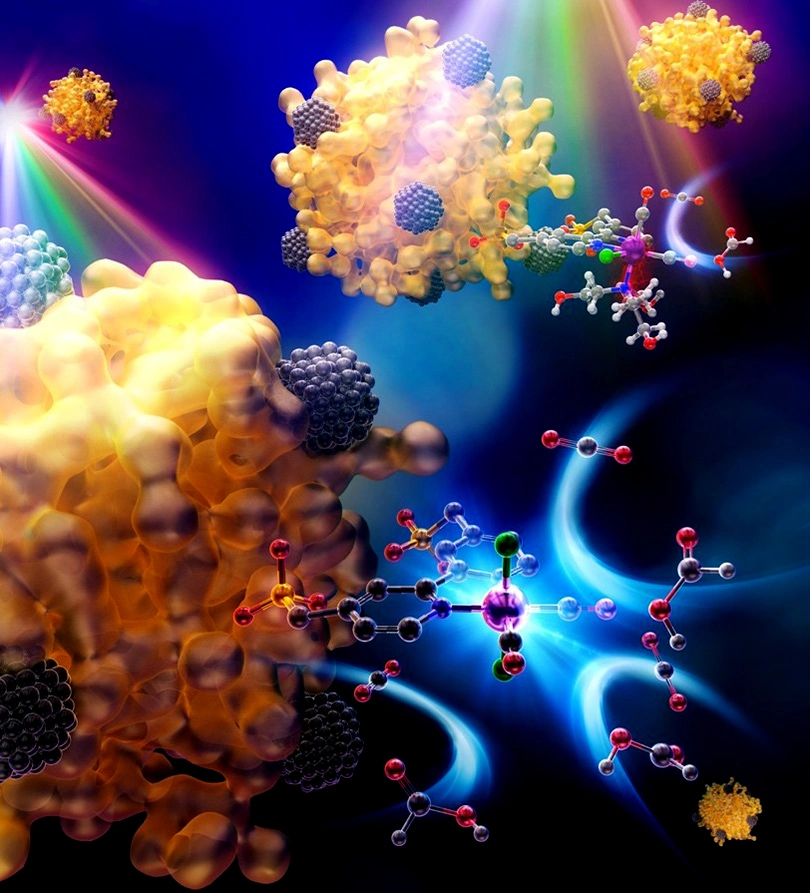
図1. ルテニウム錯体分子/銀ナノ粒子担持窒化炭素ハイブリッド光触媒によるCO2還元のイメージ図
<関連情報>
可視光CO2還元用Ru錯体/Ag/高分子窒化炭素ハイブリッド光触媒における隠れた限界の起源の解明 Elucidating the Origin of Hidden Limitations in Ru-Complex/Ag/Polymeric Carbon Nitride Hybrid Photocatalysts for Visible-Light CO2 Reduction
Ryuichi Nakada,Rikuya Nagao,Jo Onodera,Xian Zhang,Masahito Oura,Megumi Okazaki,Toshiya Tanaka,Riku Koda,Minato Tanaka,Ken Onda,and Kazuhiko Maeda
Journal of the American Chemical Society Published: February 5, 2026
DOI:https://doi.org/10.1021/jacs.5c21374
Abstract
Artificial photosynthesis that converts CO2 into value-added chemicals under mild conditions remains a key goal in sustainable catalysis. Hybrid photocatalysts that integrate molecular CO2 reduction cocatalysts with semiconductor light absorbers provide a versatile platform to combine molecular-level selectivity with solid-state photostability. However, their quantum efficiencies have generally remained low, partly because side reactions of the molecular component have been overlooked. Here we show that suppressing a photochemical ligand-exchange reaction of a surface-anchored Ru complex, trans(Cl)-[Ru(bpy(CH2PO3H2)2)(CO)2Cl2], markedly enhances photocatalytic CO2 reduction over a well-established Ag-loaded polymeric carbon nitride hybrid. The suppression of this undesirable photochemical reaction is achievable under low-intensity visible light when the Ru complex is loaded at a high density. The optimized system achieves selective CO2-to-formate conversion with an apparent quantum yield of 27.7% at 400 nm and a formate selectivity greater than 99%. Spectroscopic analyses reveal that the suppression of photochemical ligand exchange maintains the original Ru coordination environment with large driving force for CO2 reduction, thereby stabilizing the catalytic cycle and facilitating efficient interfacial electron transfer. These results reveal an unrecognized limitation in molecule/semiconductor hybrid photocatalysts─photochemical ligand exchange of the molecular cocatalyst─and demonstrate that controlling such side reactions offers an important strategy to design high-efficiency CO2 reduction systems.