

2026-03-19 ミュンヘン大学(LMU)
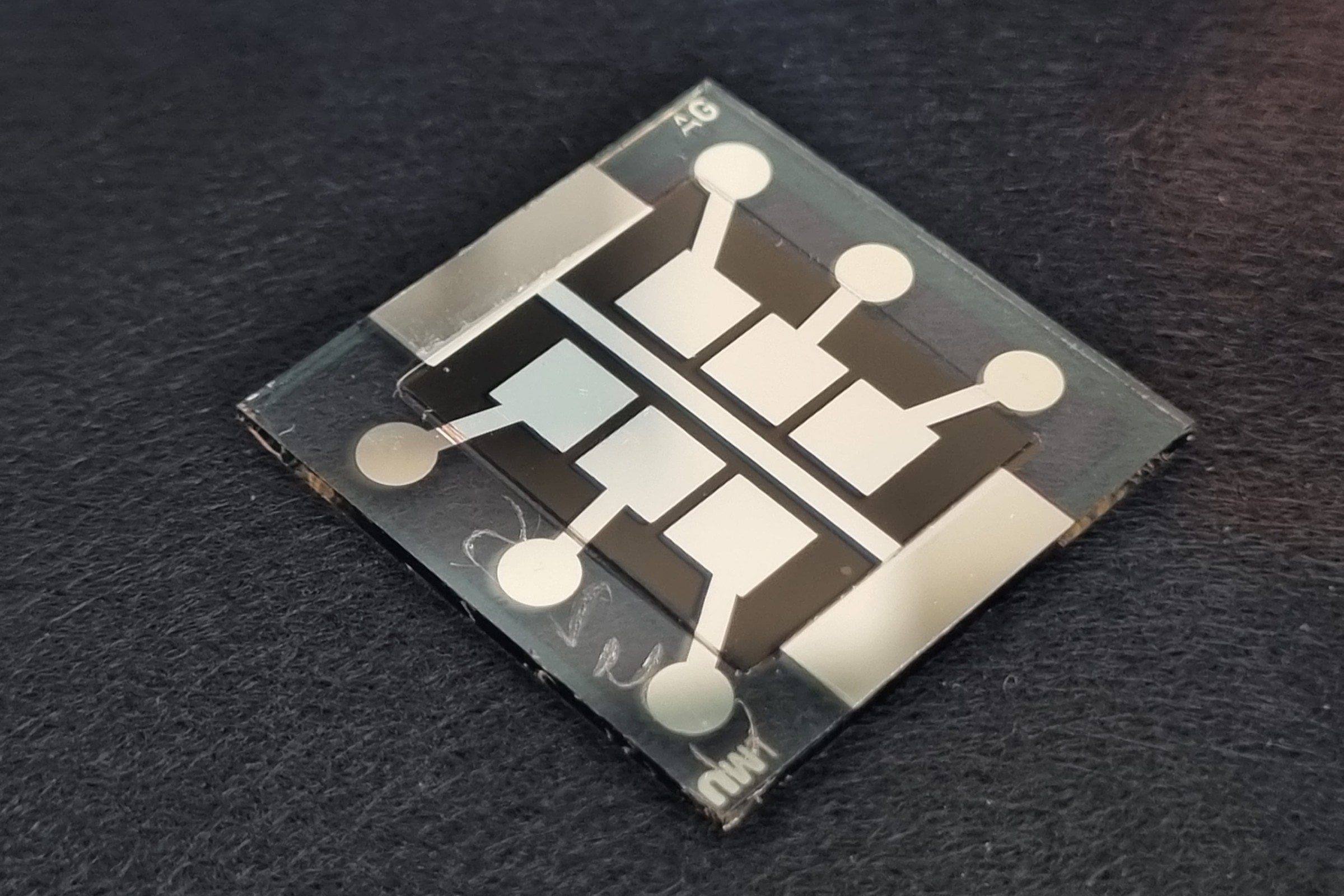
LMU-fabricated, space-grade encapsulated perovskite solar cells used in this work. | © Aydin Group
<関連情報>
- https://www.lmu.de/en/newsroom/news-overview/news/more-stable-perovskite-solar-cells-for-extreme-temperature-fluctuations-1051b23e.html
- https://www.nature.com/articles/s41467-026-70293-7#data-availability
極端な温度サイクル下での熱疲労耐性が向上したペロブスカイト太陽電池 Perovskite solar cells with enhanced thermal fatigue resistance under extreme temperature cycling
Cem Yilmaz,Ali Buyruk,Yating Shi,Sergej Levashov,Xiaole Li,Rik Hooijer,Jian Huang,Hao Zhu,Oliver Fischer,Martin C. Schubert,Caner Deger,Ilhan Yavuz,Esma Ugur,Gilles Lubineau,Johanna Eichhorn,Fei Zhang & Erkan Aydin
Nature Communications Published:09 March 2026
DOI:https://doi.org/10.1038/s41467-026-70293-7 Unedited version
Abstract
Metal halide perovskite solar cells combine high power density with low-cost manufacturing, but durability under repeated extreme temperature cycling remains insufficiently understood. We investigate thermal fatigue under cycling between −80 °C and +80 °C as an accelerated stress protocol. Mismatched thermal expansion between the perovskite absorber and glass substrate induces biaxial tensile strain, leading to degradation at the substrate–perovskite interface and within grain boundaries. To mitigate these failure modes, we introduce a co-additive molecular strategy based on lipoic acid, dihydrolipoic acid, and a sulfonium-based derivative to enhance interfacial adhesion, while in situ polymerization during annealing reinforces grain-boundary cohesion. This dual reinforcement improves robustness and performance, achieving stabilized efficiencies of 26% under standard solar illumination. Devices retain 84% of initial efficiency after 16 extreme temperature cycles. Our experiments reveal that thermal exposure duration is more critical than cycle number, with most degradation occurring during initial cycles.

