

2026-03-04 東京科学大学
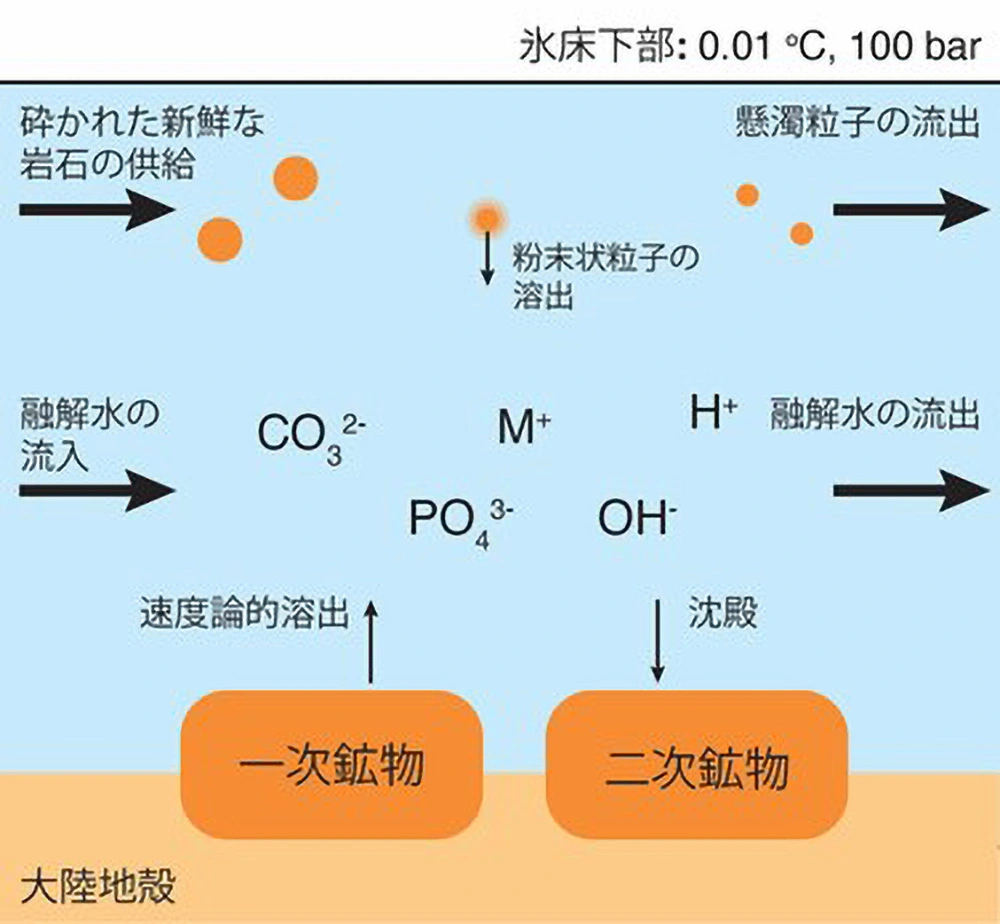
図1. 本研究で用いたモデルの模式図
<関連情報>
- https://www.isct.ac.jp/ja/news/6j3780s9tqzw
- https://www.sciencedirect.com/science/article/pii/S0012821X26000208
スノーボールアースの期間中の大陸の継続的な風化は、温室効果ガスの蓄積を緩和し、地球規模の氷河期を長期化させた Continued continental weathering during snowball earth mitigated greenhouse gas buildup and prolonged global glaciation
Shintaro Kadoya, Mohit Melwani Daswani
Earth and Planetary Science Letters Available online: 22 January 2026
DOI:https://doi.org/10.1016/j.epsl.2026.119837
Highlights
- Geochemical models reveal why ancient global ice ages lasted vastly different times.
- Rock weathering continued beneath global ice, challenging standard theory.
- Water-rock supply balance controls carbon removal during snowball Earth events.
- Subglacial weathering may have extended ice age duration via a feedback loop.
- New quantified mechanism offers explanation for major climate puzzle.
Abstract
Global glaciations, also known as snowball events, represent some of Earth’s most significant climate changes. The Neoproterozoic Sturtian glaciation lasted 4–15 times longer than the subsequent Marinoan glaciation, but the causes of this dramatic difference remain unclear. The standard theory attributes the termination of such events to a pause in silicate weathering due to the absence of liquid water on continents. However, recent evidence of syn-glacial dolomite precipitation suggests the possibility of continental weathering during global glaciation. We numerically investigate water-rock reactions under limited water and fresh rock supplies to identify the key factors controlling subglacial weathering and to evaluate their impact on the carbon cycle during global glaciation. The compositions of the discharge fluid and mineral assemblage reach their steady state over a timescale determined by the rate of fresh rock supply. These steady-state compositions are identical when the ratio of the meltwater production rate (Fw) to the fresh rock supply rate (Fr) is constant (Fw/Fr=k). Furthermore, the maximum estimated CO2 consumption could match Earth’s volcanic CO2 emission, assuming present-day Antarctic conditions for meltwater production and fresh rock supply. This finding contradicts the standard assumption that silicate weathering ceases during global glaciation and suggests a mechanism for the prolonged duration of the Sturtian glaciation. These results demonstrate that subglacial weathering represents a previously unrecognized feedback mechanism that could account for the dramatically different durations of Neoproterozoic snowball Earth

