2026-02-24 神戸大学
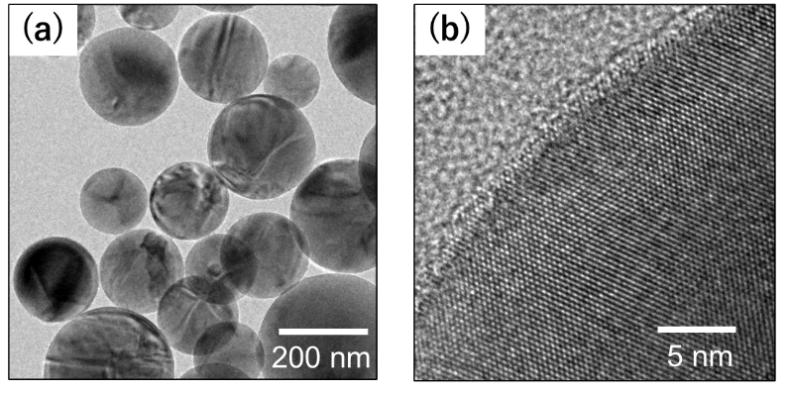
(a) シリコンナノ粒子の透過型電子顕微鏡像と、 (b) 同高分解能像(b)より、シリコン結晶の格子じまが明瞭に見られ、結晶性が高いことがわかる。杉本泰(CC BY)
<関連情報>
- https://www.kobe-u.ac.jp/ja/news/article/20260224-67595/
- https://pubs.acs.org/doi/10.1021/acsphotonics.5c02955
Mie共鳴シリコンナノスフィアに結合したMoS2のヘリシティ分解ラマン応答の調整 Tailoring the Helicity-Resolved Raman Response of MoS2 Coupled to Mie-Resonant Silicon Nanospheres
Mojtaba Karimi Habil,Hiroshi Sugimoto,Daisuke Shima,Hiroto Shinomiya,Minoru Fujii
ACS Photonics Published: February 23, 2026
DOI:https://doi.org/10.1021/acsphotonics.5c02955
Abstract
High-index all-dielectric nanoantennas supporting Mie resonances provide a versatile platform for tailoring light–matter interactions. However, their effect on the helicity of emission from nearby emitters is poorly understood. Here, we investigate the Raman intensity and degree of circular polarization (DOCP) in few-layer MoS2 coupled to the Mie resonances of silicon nanospheres (Si NSs). Theoretical analysis shows that a circularly polarized (CP) emitter near a Si NS exhibits strong radiative enhancement at the magnetic dipole (MD) and magnetic quadrupole (MQ) modes while largely preserving the ellipticity. In contrast, Au NSs provide no considerable enhancement and significantly degrade the ellipticity in their near field. Experimentally, the helicity of the out-of-plane vibration of chalcogen atoms in Si NS/MoS2 structures is well preserved at ED, MD, and MQ resonances. These results reveal Mie-mode-selective control of Raman intensity and helicity, highlighting the advantages of Si NSs for valleytronics, helicity-resolved Raman spectroscopy, and chiral nanophotonics.