2025-12-25 国際農研,農研機構
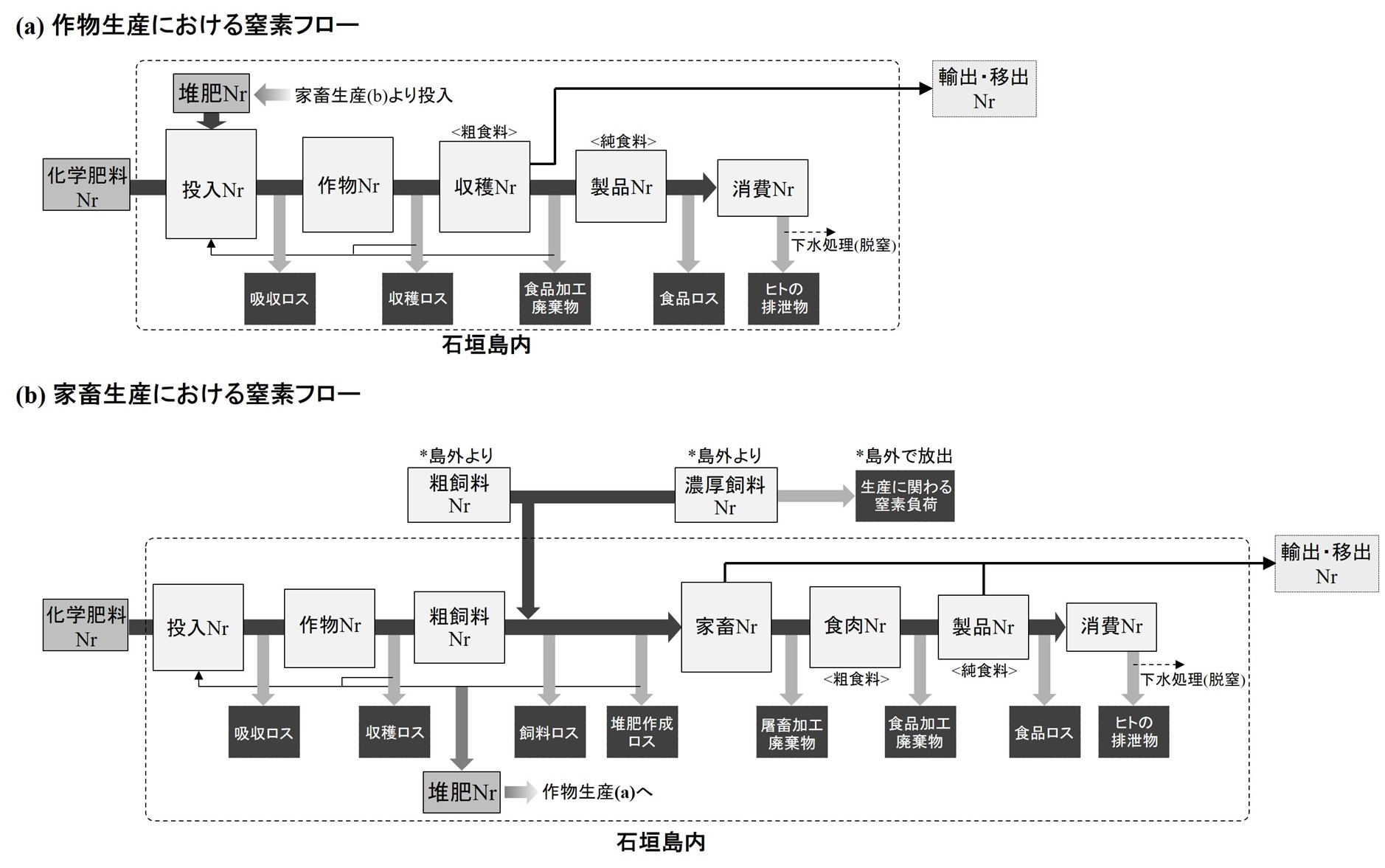
図1 食の窒素フットプリント計算フレームの概要
<関連情報>
- https://www.jircas.go.jp/ja/release/2025/press202523
- https://www.jircas.go.jp/system/files/press/press202523.pdf
- https://iopscience.iop.org/article/10.1088/1748-9326/ae0b95
生産と消費者の同時努力が日本の島の食料システムにおける窒素負荷を軽減 Simultaneous production and consumer efforts reduce the nitrogen load in a Japanese island’s food system
Kosuke Hamada, Sadao Eguchi, Nanae Hirano and Kei Asada
Environmental Research Letters Published: 10 October 2025
DOI:10.1088/1748-9326/ae0b95
Abstract
Issues related to reactive nitrogen (Nr) continue to increase and have exceeded planetary boundaries. Both production- and consumer-level efforts can mitigate Nr loads and inputs. However, only independent evaluations of these efforts have been performed thus far, and the lack of comprehensive evaluations has hindered further reductions in Nr loads and inputs. Therefore, in this study, we applied the food nitrogen footprint to a subtropical island in Japan and evaluated both direct (on-island) and indirect (overseas-related, imported food/feed production) Nr loads and inputs within the food system. The following scenarios were developed: shifting diets toward grains and legumes in imported food, halving food loss and using the remainder as concentrate feed, and replacing chemical fertilizers with cattle manure produced on the island. Altering the composition of imported food, reducing food loss by half, and utilizing the remaining portion as feed effectively reduced the indirect Nr load, while using cattle manure reduced the direct Nr load. Implementing these measures in combination reduced the direct and indirect Nr loads by 15.4% and 30.9% and the direct and indirect Nr inputs by 19.8% and 18.8%, respectively. Therefore, it is essential to implement consumer and production efforts simultaneously rather than independently to optimize the global nitrogen cycle.