2025-12-22 コロンビア大学
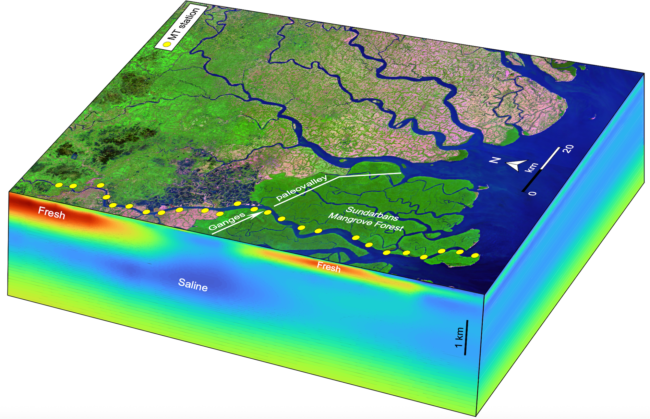
The Ganges incised paleovalley separates the freshwater reservoirs beneath the survey area, shown in 3D view. Courtesy of Huy Duc Le
<関連情報>
- https://news.climate.columbia.edu/2025/12/22/vast-freshwater-reserves-found-beneath-salinity-stressed-coastal-bangladesh/
- https://www.nature.com/articles/s41467-025-65770-4
塩分濃度の高いバングラデシュ沿岸部の地下に埋蔵された深層淡水資源 Buried deep freshwater reserves beneath salinity-stressed coastal Bangladesh
Huy Le,Kerry Key,Michael S. Steckler,Nafis Sazeed,Mark Person,Anwar Bhuiyan,Mahfuzur R. Khan & Kazi M. Ahmed
Nature Communications Published:28 November 2025
DOI:https://doi.org/10.1038/s41467-025-65770-4
Abstract
Aquifer overexploitation and saltwater intrusion threaten freshwater resources in coastal regions worldwide. In Bangladesh, arsenic contamination further reduces shallow freshwater availability. In the coastal zone, much of the shallow groundwater is saline, while the availability of deeper fresh groundwater remains poorly understood. Here, we utilize deep-sensing magnetotelluric soundings to image contrasts in electrical resistivity between fresh and saline groundwater along the Pusur River in the Ganges-Brahmaputra Delta. Our data reveal two distinct deep freshwater bodies separated by a high-salinity zone. We propose that these aquifers formed during the Last Glacial Maximum sea-level lowstand and are protected by overlying fine-grained sediments, whereas the Ganges paleovalley incision, followed by marine transgression and deposition, created the saline gap. Our work maps potential resources for this water-stressed region and suggests that the interplay between past sea-level cycles, sedimentation, and hydrogeological processes demonstrated here may also control the distribution of fresh groundwater in other deltas.