2025-09-27 量子科学技術研究開発機構,高エネルギー加速器研究機構,住友重機械工業株式会社,九州大学,山形大学,科学技術振興機構
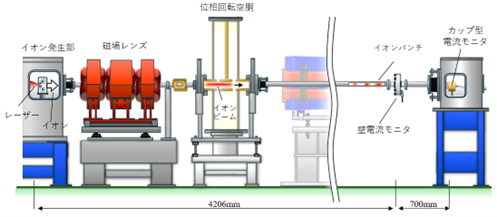
位相回転空胴によるイオン速度制御の装置概要図
<関連情報>
- https://www.jst.go.jp/pr/announce/20250927/index.html
- https://www.jst.go.jp/pr/announce/20250927/pdf/20250927.pdf
- https://pubs.aip.org/aip/rsi/article/96/9/093307/3364673/Demonstration-and-real-time-non-destructive
高フラックスレーザー駆動陽子バンチの実証とリアルタイム非破壊診断
Demonstration and real-time non-destructive diagnosis of a high-flux laser-driven proton bunch
Hironao Sakaki;Sadaoki Kojima;Tsuyoshi Suwada;Thanh-Hung Dinh;Hiroshi Tsutui;Yutaka Touchi;Kiyotaka Ohtomo;Haruya Matsumoto;Nobuatsu Aoki;Hikaru Souda;Masayasu Hata;Yoichi Yamamoto;Fuyumi Itou;Masaharu Nishikino;Toshiyuki Shirai;Kiminori Kondo
Review of Scientific Instruments Published:September 26 2025
DOI:https://doi.org/10.1063/5.0274838
To realize a compact and high-intensity ion beam facility based on laser-driven ion acceleration by Target Normal Sheath Acceleration, we constructed a dedicated beamline capable of transporting and controlling proton beams with kinetic energy of 1.5 MeV. The system consists of a quadrupole triplet electromagnet for spatial focusing and an energy-compressing cavity (ECC) for longitudinal phase rotation, enabling momentum compression. A wall current monitor (WCM), installed 4.2 m downstream of the source, enables real-time, non-destructive bunch diagnostics. Using this setup, a single-bunch proton with a kinetic energy of 1.5 MeV was generated from a 5.0 μm-thick nickel tape target and compressed by phase rotation in the ECC. The time-domain standard deviation of the bunch length, as measured by the WCM, was found to be less than 0.14 ns (limited by the measurement resolution), and the bunch was transversely focused to a root-mean-square diameter of ∼10 mm at the WCM position, as determined from beam transport simulations. The single-shot irradiation fluence exceeded 5.5 × 10⁷ (protons/cm2)/bunch with an energy spread of 4.6%, corresponding to a peak flux of ∼1017 (protons/cm2)/s. Such a low-energy, sub-nanosecond, high-flux single-bunch proton beam is extremely difficult to achieve with conventional ion accelerator systems. It enables experimental investigation of fundamental material damage processes with high temporal resolution, including early stage defect formation and atomic displacements. This laser-driven ions beam study is expected to significantly advance time-resolved applications requiring sub-nanosecond temporal resolution, particularly in the fields of advanced materials research.