2025-08-11 カリフォルニア工科大学(Caltech)
ChatGPT:
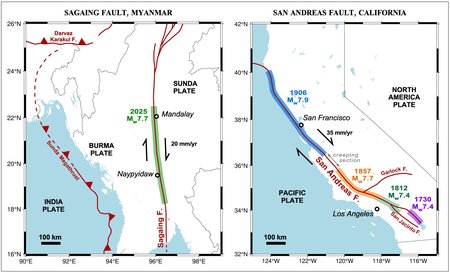
Maps of the Sagaing Fault (left) and the San Andreas (right). Both are strike-slip faults, with two sides moving past one another. Sections of each fault, highlighted in color, have ruptured in historical earthquakes. In a new study, Caltech researchers demonstrate that these kinds of faults can rupture along longer sections than predicted, causing larger earthquakes.Credit: S. Antoine
<関連情報>
- https://www.caltech.edu/about/news/imaging-and-modeling-of-myanmar-quake-gives-clues-about-behavior-of-the-san-andreas
- https://www.pnas.org/doi/10.1073/pnas.2514378122
2025年ミャンマー・マンダレーMw7.7地震は、サガイン断層におけるクラスタリングと変異するセグメンテーションを示す複雑な地震サイクルを明らかにした The 2025 Mw7.7 Mandalay, Myanmar, earthquake reveals a complex earthquake cycle with clustering and variable segmentation on the Sagaing Fault
Solene L. Antoine, Rajani Shrestha, Chris Milliner, +4 , and Jean-Philippe Avouac
Proceedings of the National Academy of Sciences Published:August 11, 2025
DOI:https://doi.org/10.1073/pnas.2514378122
Significance
Large earthquakes often occur on faults that were known to have produced destructive events in the past. However, anticipating the characteristics of these earthquakes and their impacts remains a great challenge. The 2025 Mw7.7 Mandalay earthquake was produced by rupture of an unusually long stretch of the Sagaing Fault in Myanmar, primarily a section that had not broken since 1839 and was considered a zone of high hazard, as well as sections that experienced more recent earthquakes. These observations challenge the usual approaches used in seismic hazard studies to evaluate how a fault is spatially divided and strain is built up and released over time. We show that physics-based simulations of earthquake sequences can provide an alternative approach.
Abstract
We use remote sensing observations to document surface deformation caused by the 2025 Mw7.7 Mandalay earthquake. This event is a unique case of an extremely long (~510 km) and sustained supershear rupture probably favored by the rather smooth and continuous geometry of this section of the structurally mature Sagaing Fault. The seismic rupture involved the locked portion of the fault over its entire depth extent (0 to 13 km) with a remarkably uniform slip distribution that averages 3.3 m, and an average stress drop of 4.7 MPa. No shallow-slip deficit is observed. The rupture extent challenges usual scaling laws relating earthquake magnitude, fault length, and slip. The fault ruptured along a known seismic gap that last ruptured in 1839 and tailed off into sections that ruptured during large earthquakes in 1930 and 1946. The amplitude and spatial distribution of fault slip in the 2025 event conform only approximatively to the slip-predictable model and the segmentation inferred from the fault geometry and past ruptures. Plausible sequences of earthquakes with variable magnitude, segmentation, and return periods, including events similar to the 2025 earthquake are produced in quasidynamic simulations using a simplified but nonplanar fault geometry. Based on this simulation, Mw>7.5 events return irregularly with an interevent time of ~141 y on average and a SD of ~40 y. The simulation is consistent with the historical seismicity and with the maximum magnitude ~Mw7.9 and return period (~250 y) derived from moment conservation. Data assimilation into such simulations could provide a way for time-dependent hazard assessment in the future.