2025-07-30 オックスフォード大学
<関連情報>
- https://www.ox.ac.uk/news/2025-07-30-oxford-chemists-identify-honey-offering-2500-year-old-shrine
- https://pubs.acs.org/doi/full/10.1021/jacs.5c04888
不死の象徴: 紀元前530~510年のパエストゥム祠堂で発見された青銅壷の蜂蜜の証拠 A Symbol of Immortality: Evidence of Honey in Bronze Jars Found in a Paestum Shrine Dating to 530–510 BCE
Luciana da Costa Carvalho,Elisabete Pires,Kelly Domoney,Gabriel Zuchtriegel,and James S. O. McCullagh
Journal of the American Chemical Society Published: July 30, 2025
DOI:https://doi.org/10.1021/jacs.5c04888
Abstract
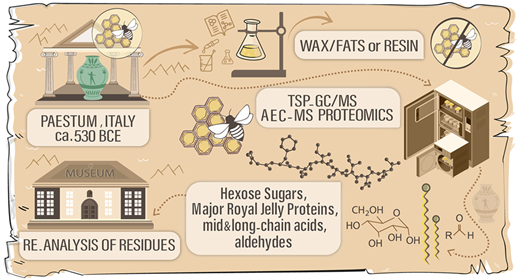
This study re-examines a 2500-year-old residue found in bronze jars at an underground shrine in Paestum (Italy), previously identified as a wax/fat/resin mixture excluding honey from its composition. Our multianalytical approach detected lipids, saccharide decomposition products, hexose sugars, and major royal jelly proteins supporting the hypothesis that the jars once also contained honey/honeycombs. The research highlights the value of reinvestigating archeological residues in museums with advanced biomolecular techniques and offers a more specific method for detecting bee products in ancient contexts.