2025-07-21 パシフィック・ノースウェスト国立研究所(PNNL)
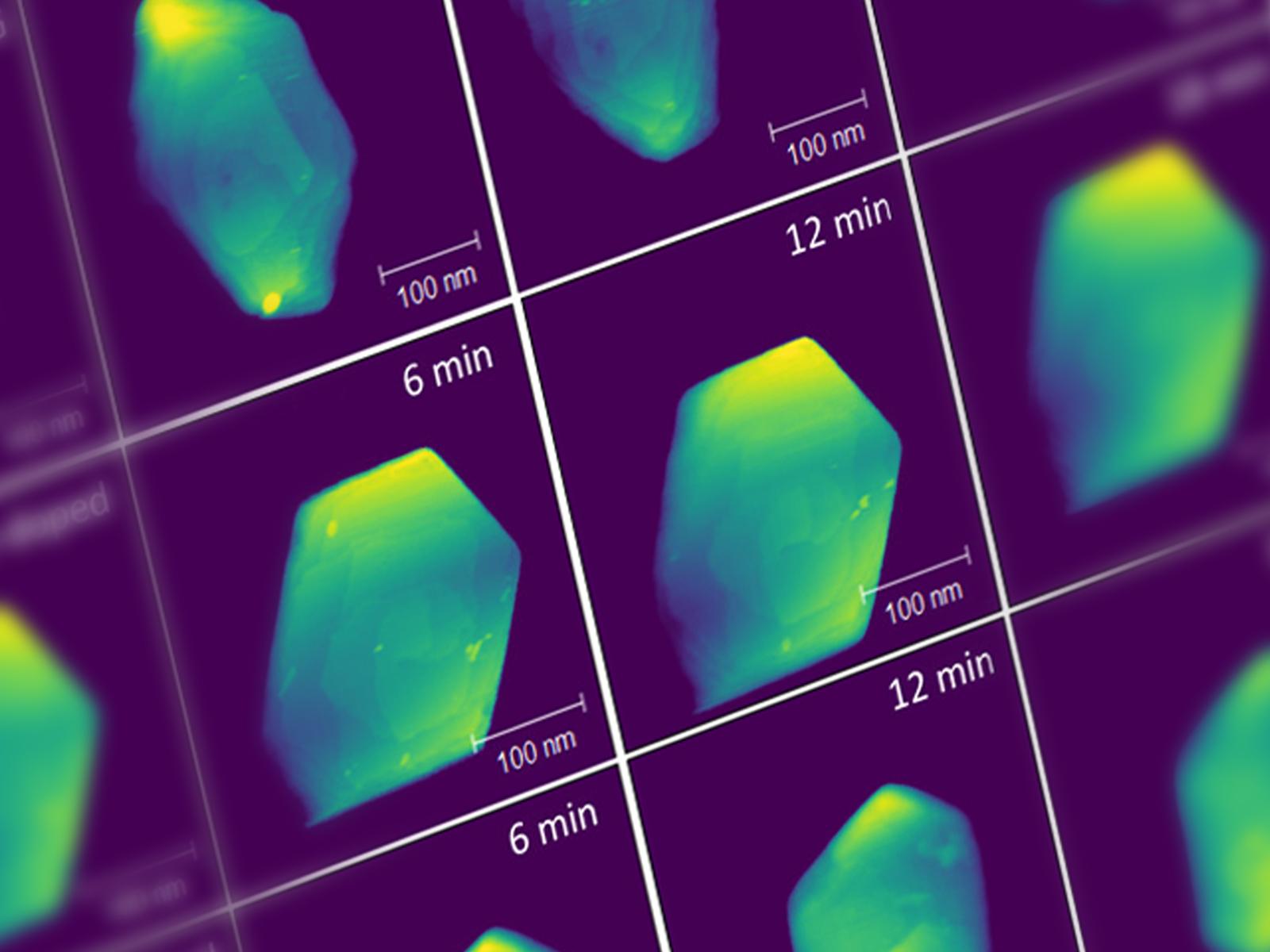
The presence of small amounts of iron or chromium can significantly slow the dissolution of gibbsite.
(Composite image by Jeff London | Pacific Northwest National Laboratory)
<関連情報>
- https://www.pnnl.gov/publications/ion-incorporation-affects-mineral-behavior
- https://pubs.acs.org/doi/full/10.1021/acs.est.4c04483
ギブサイト結晶化過程における微量鉄とクロムの取り込みと鉱物溶解への影響の解明 Understanding Trace Iron and Chromium Incorporation During Gibbsite Crystallization and Effects on Mineral Dissolution
Yatong Zhao,Micah P. Prange,Meirong Zong,Yining Wang,Eric D. Walter,Ying Chen,Zihua Zhu,Mark H. Engelhard,Xiang Wang,Xiaodong Zhao,Carolyn I. Pearce,Aijun Miao,Zheming Wang,Kevin M. Rosso,and Xin Zhang
Environmental Science & Technology Published: October 29, 2024
DOI:https://doi.org/10.1021/acs.est.4c04483
Abstract
Incorporation of pollutants, e.g., heavy metals, or critical elements, e.g., lithium, as impurities in mineral phases can significantly affect their mobility or sequestration in the environment. Even when present at low concentrations, impurities can alter the solubility and reactivity of the host mineral. In this study, we investigate the incorporation of trace amounts of iron (Fe3+) and chromium (Cr3+) during the crystal growth of the aluminum (Al3+) hydroxide, gibbsite, a major component of bauxite ores, an important soil mineral, and a dominant mineral phase in stored radioactive wastes. Using a comprehensive suite of analytical techniques, we show that both Cr3+ and Fe3+ can be incorporated into the gibbsite lattice during coprecipitation by replacing Al3+ in octahedral sites. These small amounts are consistent with limited to no structural isomorphism shared between Al3+ and Cr3+/Fe3+ hydroxide precipitates, nor room temperature miscibility of their isostructural M2O3 oxide forms, in contrast with oxyhydroxide forms where Al3+ and Fe3+ share similar structural topologies. Despite the limited uptake of Cr3+/Fe3+, we show that these impurities have significant implications for gibbsite dissolution behavior. The limited uptake of Cr3+/Fe3+ (e.g. 0.43% Cr3+ and 0.4% Fe3+), we show that these impurities have significant implications for gibbsite dissolution behavior and subsequent reactivity in complex environments.