2026-11-11 水産研究・教育機構
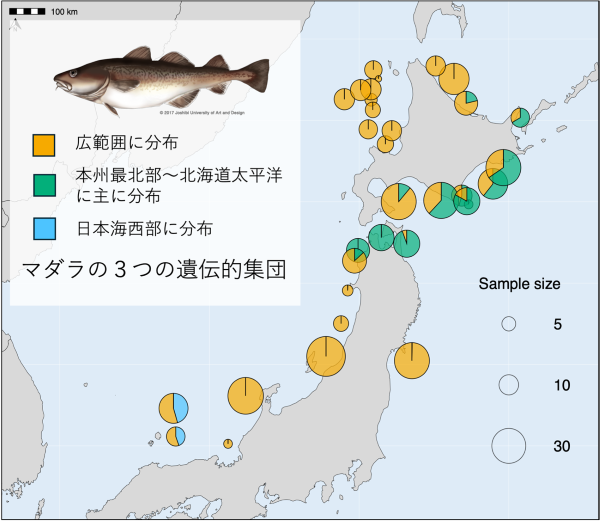
図 「日本周辺におけるマダラの3つの遺伝的集団の分布」
各地点の円グラフは、採集したマダラに占める3つの遺伝的集団の割合を示しています。
円の大きさは各地点で解析した個体数を表します。
<関連情報>
- https://www.fra.go.jp/home/kenkyushokai/ronbun/2026/20261111.html
- https://academic.oup.com/icesjms/article/83/10/fsag203/8915701
日本海域における太平洋タラの遺伝的集団構造と個体群動態史 Genetic population structure and demographic history of Pacific cod in Japanese waters
Akira S Hirao , Kay Sakuma , Tetsuya Akita , Satoru N Chiba
ICES Journal of Marine Science Published: 14 October 2026
DOI:https://doi.org/10.1093/icesjms/fsag203
Abstract
Pacific cod is a key species in North Pacific fisheries, and its stock assessment and management units are separated according to biological, geographical, and administrative information. Understanding the fine-scale genetic population structure of this species is crucial for effective management, particularly in regions such as Japan, where complex coastal geography and localized fisheries management prevail. Therefore, in this study, we analysed genome-wide single nucleotide polymorphisms (SNPs; 6036 loci) in 495 individuals of Pacific cod sampled from 33 sites around the Japanese archipelago via genotyping by random amplicon sequencing-direct (GRAS-Di) analysis. Our analyses revealed three major genetic groups: Japanese Broad Range, Northernmost Honshu–Hokkaido (NHH), and Western Sea of Japan groups. These groups exhibited significant genetic differentiation (global FST = 0.056), distinct levels of nucleotide diversity, and group-specific patterns of Tajima’s D. Moreover, demographic history reconstruction based on whole-genome sequencing of three representative individuals revealed that each genetic group followed distinct demographic trajectories since the last glacial period. Importantly, the NHH group, related to the Mutsu Bay spawning aggregation and previously shown to exhibit strong natal homing in tagging surveys, was genetically identified for the first time in this study. Isolation-by-distance was observed across Japanese waters and within the Japanese Broad Range group, but not within the NHH group, suggesting that gene flow is generally restricted by geographic distance, except within the NHH group. To evaluate the potential for genetic stock identification (GSI), we extended a resampling-based cross-validation framework by incorporating outlier detection to assess marker selection strategies. Over 500 background SNPs were required to achieve > 90% assignment accuracy for GSI, whereas only eight or more outlier SNPs showed comparable performance. These findings suggest that carefully selected SNP panels, particularly those including outlier loci, substantially improve stock discrimination. Overall, our study demonstrates the fine-scale genetic structure and demographic history of Pacific cod in Japanese waters and highlights the utility of practical marker strategies for enhancing the biological realism of fisheries assessment and supporting sustainable fisheries management.