2026-11-10 北海道大学,国⽴環境研究所,⽇本原⼦⼒研究開発機構,国際農林⽔産業研究センター
北海道大学などの共同研究グループは、北海道北部の森林泥炭地で16年間にわたる土壌加温実験を実施し、地温上昇が土壌からのCO₂放出に及ぼす長期的影響を明らかにした。2007~2022年に土壌を平均約3℃加温し、微生物による土壌有機物の分解に伴うCO₂放出量(微生物呼吸)を継続観測した。その結果、加温区では微生物呼吸量が16年間の平均で111%増加し、実験最終年にも高い増加率が維持されていた。こうした長期的な温暖化応答には、泥炭地に蓄積された豊富な土壌有機炭素、加温に伴う土壌水分の低下、土壌深部における細菌・真菌量の増加が関与していることが分かった。従来、多くの鉱質土壌では温暖化による微生物呼吸の増加は10年以上持続しないと考えられていたが、本研究は泥炭地では異なる応答が生じることを示した。泥炭地が温暖化によって持続的なCO₂放出源となり、気候変動をさらに加速させる可能性を示す重要な成果である。
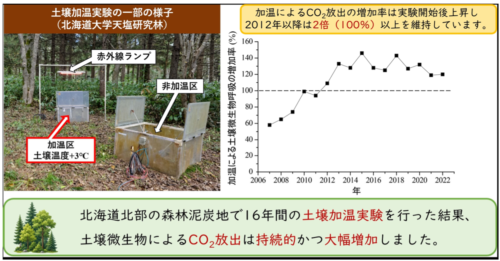
図1. 本研究で⽤いたシステム及び主要な結果
<関連情報>
- https://www.hokudai.ac.jp/news/2026/11/163co22.html
- https://www.hokudai.ac.jp/news/pdf/261110_pr.pdf
- https://www.sciencedirect.com/science/article/abs/pii/S0038071726001318
北⽅林の泥炭地における⼟壌加温に伴う16年間にわたる⼟壌微⽣物呼吸量の持続的な増加 Continuous acceleration of soil heterotrophic respiration over 16 years of soil warming in a sub-boreal forested peatland
Ruiqi Ma, Kentaro Takagi,Toshiaki Kondo,Jun Koarashi,Mariko Atarashi-Andoh,Kobayashi Makoto,Maricar Aguilos,Kira Ryhti-Laine,Lifei Sun,Yoshiyuki Takahashi,Takashi Hirano,Naishen Liang
Soil Biology and Biochemistry Available online: 1 June 2026
DOI:https://doi.org/10.1016/j.soilbio.2026.110212
Highlights
- Warming caused a strong increase in Rh in a cool-temperate forested peatland.
- Beyond direct warming, Rh rose due to soil moisture loss and higher microbial abundance.
- Doubling of basal respiration kept the warming effect above 100% in final 11 years.
- Peatlands may shift to large carbon sources under sustained warming.
Abstract
Global warming is increasingly recognized as a critical driver of carbon release from terrestrial ecosystems, yet the magnitude and persistence of this effect remain uncertain. This study investigates the impact of sustained warming on soil carbon decomposition by measuring soil heterotrophic respiration (Rh) in a sub-boreal forested peatland in northern Hokkaido, Japan, over a 16-year period. We compared three treatments: root-trenched (Rh), root-trenched with +3 °C warming at 5 cm depth (warmed Rh), and a control allowing root invasion. We evaluated interannual variations in Rh, temperature sensitivity (Q10), and basal respiration rate at 10 °C (R10). Our results reveal a remarkably strong and persistent warming effect on Rh, averaging an 111% increase over 16 years (p < 0.001). This amplified response is attributed to the peatland’s substantial soil organic carbon (SOC) stocks in this site (17.7 kg C m−2 in the top 30 cm). Although there was no significant difference, we also observed that warming reduced soil water content by 6.5% over 2011–2022 (p = 0.529), which could enhance aerobics and further contribute to increased Rh. Furthermore, warming significantly increased bacterial abundances at 20–30 cm soil depth by 39% and fungal abundances at 10–20 cm depth by 84%, which also played a role in accelerating SOC decomposition. Despite a negative correlation between the seasonal average soil temperature and the warming effect (p = 0.05) observed in the later 11 years of the experiment (2012–2022), long-term warming led to a 116% increase of in R10, corresponding with the significant increase in microbial abundance. Our findings highlight the potential for peatlands to transition to large carbon sources through synergistic effects of high SOC stocks, warming-induced soil moisture loss, and increase in soil microbial abundance.