2026-09-08 愛媛大学
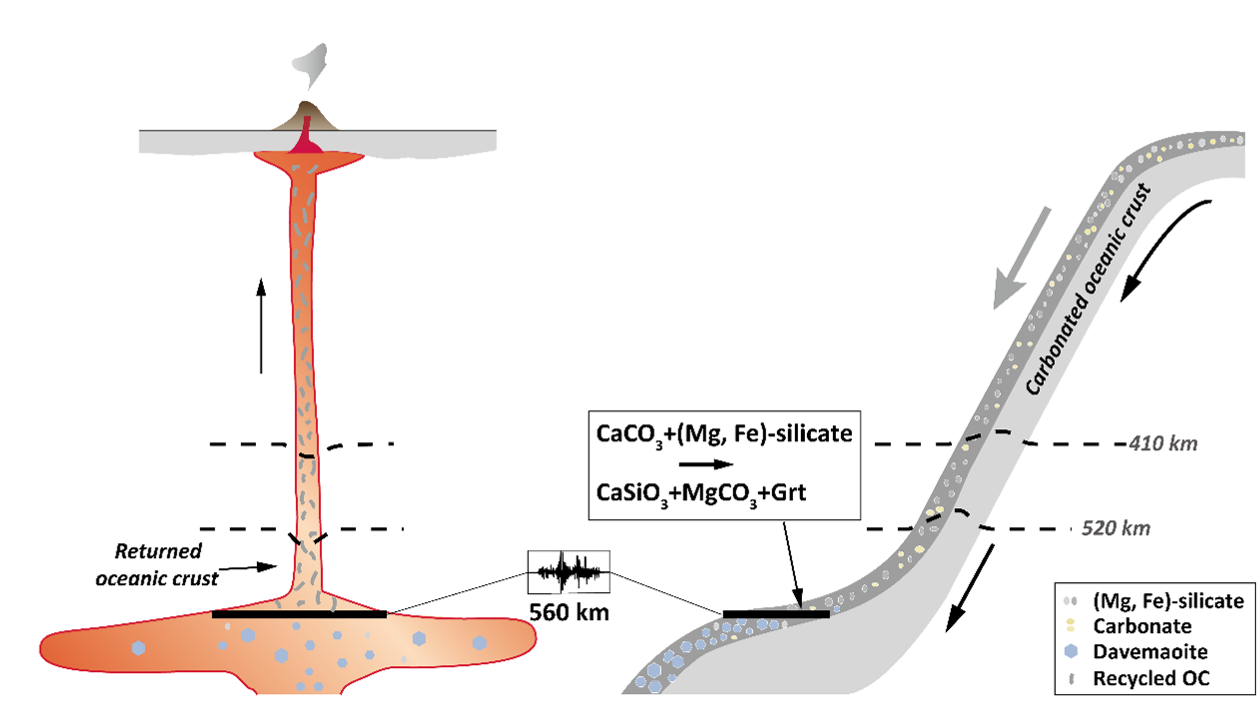
520 km不連続面の分裂(スプリッティング)形成に関する概念図
<関連情報>
- https://www.ehime-u.ac.jp/data_relese/pr_20260908_grc/
- https://www.nature.com/articles/s41467-026-76803-x
深部炭素循環が引き起こすマントル520km不連続面の分裂 Deep carbon cycling drives the splitting of the 520-km mantle discontinuity
Xinyue Zhang,Wei Wei,Youyue Zhang,Zhu Mao,Ningyu Sun,Daoyuan Sun,Wei Leng,Takashi Yoshino,Izumi Mashino,Tomoo Katsura,Jiewen Li,Wancai Li & Jung-Fu Lin
Nature Communications Published:21 August 2026
DOI:https://doi.org/10.1038/s41467-026-76803-x Early provide
Abstract
Carbon cycling into Earth’s deep interior regulates melting, redox state, and volatile transport, yet its imprint on mantle seismic structure remains unclear. A potential seismic expressure of deep carbon cycling is the sporadic splitting of the 520-km discontinuity, expressed as a secondary reflector near 560 km beneath slabs and mantle upwellings, has been attributed to davemaoite (CaSiO3) exsolution, although its shear-wave properties cannot produce the required 2–4% impedance contrast. We conduct high pressure-temperature experiments (~20 GPa, 1200–1600 °C) to determine how carbonate-altered oceanic crust reorganizes mantle layering. Here we show that carbonate addition drives Ca-Mg exchange with silicates, increases Ca incorporation into silicates under Fe-rich conditions, and enhances davemaoite exsolution. This process yields 12–33(2) vol.% davemaoite near ~ 560 km, sufficient to match impedance contrasts observed. Davemaoite-rich crust could be recycled by mantle plumes, accounting for the 560-km reflector beneath hot regions. Subducted carbonates thus reshape mineral equilibria, reinforce chemical stratification, and generate persistent seismic signatures of deep carbon cycling.