
2026-06-17 国立天文台
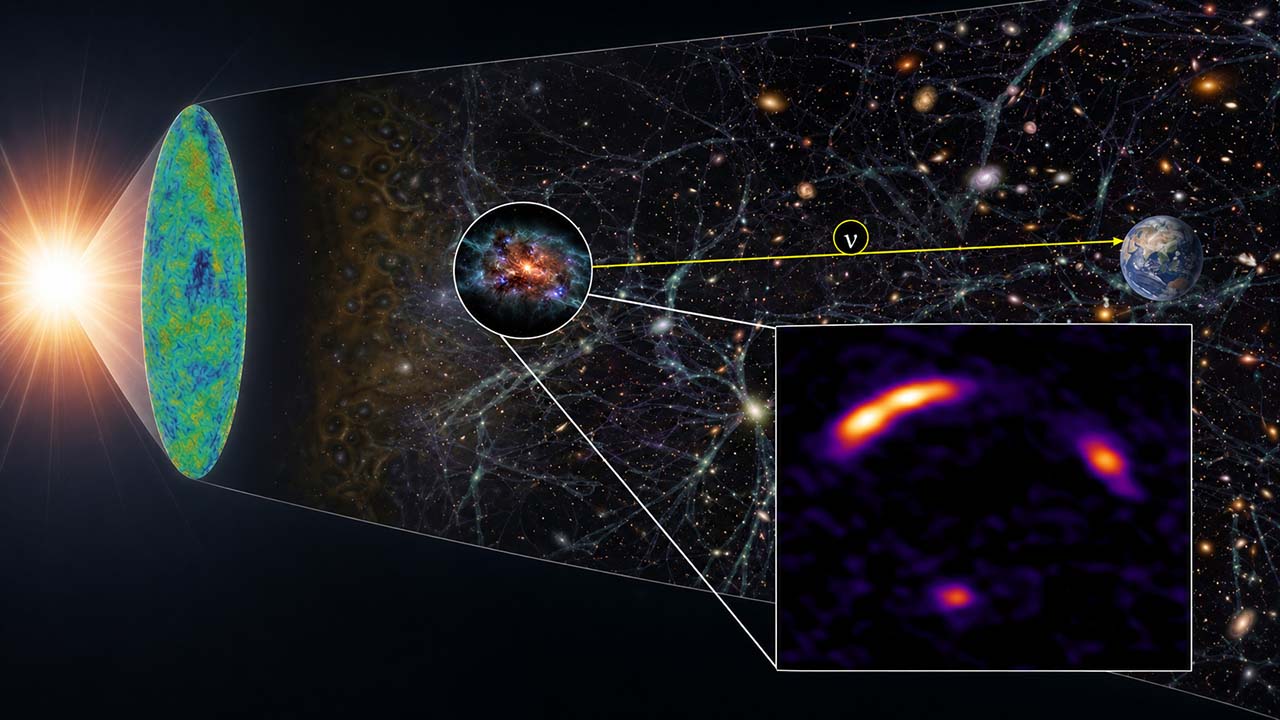
今回の発見の概念図。宇宙ニュートリノ事象「IC 210922A」の方向にある爆発的な星形成銀河「シャドウ・ブラスター」を、アルマ望遠鏡で捉えました(右下・四角で囲まれた電波画像)。ニュートリノ(ν)の起源である初期宇宙に存在するシャドウ・ブラスター(中央・丸で囲まれた想像図)が、重力レンズ効果によって4つの明るくなった像として観測されています。(クレジット:MITOS)
<関連情報>
- https://www.nao.ac.jp/news/science/2026/20260617-alma.html
- https://www.nature.com/articles/s41550-026-02884-9
宇宙の正午に発生するコンパクトな塵の星形成は、高エネルギーニュートリノと関連している Compact dusty starbursts at cosmic noon linked to high-energy neutrinos
Yuji Urata,Kuiyun Huang,Bunyo Hatsukade,Mansi Kasliwal,Shigeo S. Kimura,Yuichi Matsuda,Yusuke Miyamoto,Hiroshi Nagai,Kouichiro Nakanishi & Robert Stein
Nature Astronomy Published:17 June 2026
DOI:https://doi.org/10.1038/s41550-026-02884-9
Abstract
The origin of high-energy astrophysical neutrinos remains unresolved, and secure electromagnetic counterparts to individual events are rare despite rapid follow-up. Dusty star-forming galaxies (DSFGs) at cosmic noon (z ≈ 1–4) are natural cosmic-ray calorimeters, yet observational links between DSFGs and neutrinos have remained unknown. Here we report a compact-core DSFG within an IceCube localization, JCMT0402−0424, a quadruply lensed galaxy at z = 2.988 located inside the 90% containment region of the IceCube event IC 210922A. Atacama Large Millimeter/Submillimeter Array imaging and lens modelling resolve a highly magnified, compact starburst with no bright γ-ray or X-ray counterpart above current sensitivity limits. Considering the positional agreement, the low chance–coincidence probability (≲1%) for such an extreme submillimetre source, the absence of equally plausible alternatives in the field and the compact, gas-rich core revealed by Atacama Large Millimeter/Submillimeter Array, JCMT0402−0424 is the most plausible electromagnetic counterpart candidate within the IC 210922A localization. In a population context, compact-core starbursts at cosmic noon can provide a non-negligible population-level contribution to the diffuse high-energy neutrino background, even though the neutrino yield from any single DSFG is modest. This result connects high-energy neutrino production to the peak epoch of cosmic star formation, opening a new avenue to probe galaxy evolution and cosmic-ray acceleration across cosmic time.
