2026-05-29 中国科学院(CAS)
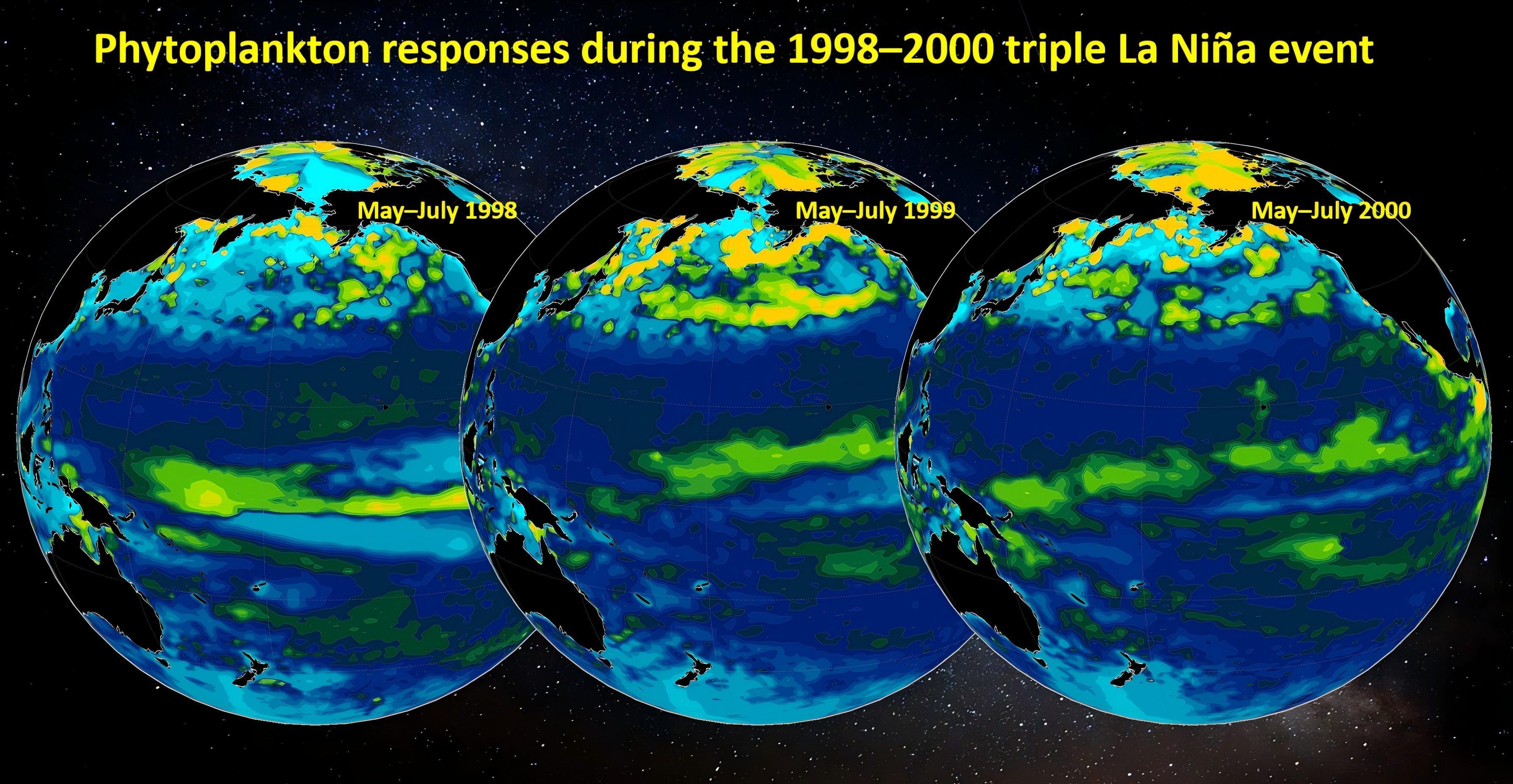
Sea surface chlorophyll anomaly distribution in late spring and early summer during the 1998–2000 triple La Niña event. (Image by IOCAS)
<関連情報>
- https://english.cas.cn/newsroom/research-news/202605/t20260529_1160098.shtml
- https://www.nature.com/articles/s43247-026-03680-z
植物プランクトンによる放射線の影響が、複数年にわたるラニーニャ現象の進化を再構築する Phytoplankton-induced radiation effects reshape the evolution of multi-year La Niña
Feng Tian,Rong-Hua Zhang,Xiujun Wang & Chuanyu Liu
Communications Earth & Environment Published:25 May 2026
DOI:https://doi.org/10.1038/s43247-026-03680-z Unedited version
Abstract
Chlorophyll in phytoplankton modulates upper-ocean heating by absorbing shortwave radiation, thereby affecting climate systems. However, how chlorophyll influences multi-year La Niña evolution—a key aspect of El Niño–Southern Oscillation diversity—remains largely unexplored. Using a coupled ocean physics–biogeochemical model, we reveal that chlorophyll patterns markedly modulate the anomalous zonal sea surface temperature gradient across the equatorial Pacific. In the western-central equatorial Pacific, increased surface chlorophyll enhances meridional advection and vertical mixing, sustaining cooling into the second year by ~8%. Conversely, reduced chlorophyll in the eastern equatorial Pacific allows deeper shortwave penetration, warming the subsurface; this subsequently promotes surface warming by ~45% via background upwelling. Additionally, the subsurface chlorophyll maximum further enhances eastern equatorial Pacific cooling, helping sustain second-year La Niña conditions. These findings identify phytoplankton-driven bio-feedback as a previously unrecognized mechanism reshaping multi-year La Niña processes.