
2025-11-07 中国科学院(CAS)
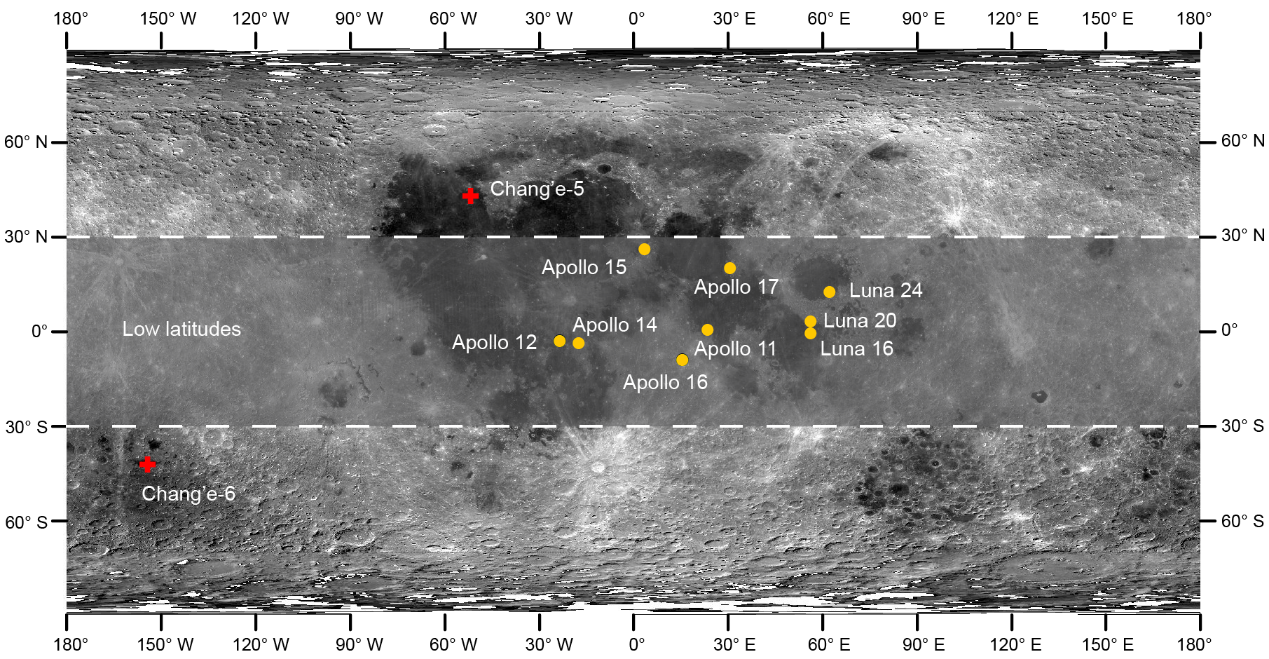
Distribution of lunar sampling sites. The Apollo and Luna missions landed at low latitudes, outlined between the two dashed white lines. In contrast, the Chang’e-5 and Chang’e-6 missions landed at mid-latitudes. (Image by LIN Honglei)
<関連情報>
- https://english.cas.cn/newsroom/research_news/earth/202511/t20251105_1096034.shtml
- https://www.nature.com/articles/s41561-025-01819-9
月の表面水の分布は緯度とレゴリスの成熟度に依存する Distribution of lunar surface water dependent on latitude and regolith maturity
Honglei Lin,Rui Chang,Rui Xu,Wei Yang,Heng-Ci Tian,Hong Tang,Jinning Li,Jialong Hao,Liyu Shan,Xiaojing Zhang,Huaiyu He,Zhiping He,Wei Lin,Yangting Lin & Yong Wei
Nature Geoscience Published:06 November 2025
DOI:https://doi.org/10.1038/s41561-025-01819-9
Abstract
Water on the surface of the Moon is a key factor in tracing lunar surface processes and represents a potential future resource for lunar exploration. Samples from the Apollo and Luna missions provide constraints on the content and possible origin of this water, but represent only low latitudes on the Moon’s nearside. Information about the lunar farside has been restricted to remote sensing observations and thus the global distribution and origin of lunar surface water are still debated. Here we performed laboratory analyses of samples from the lunar farside at mid-latitudes returned by the Chang’e-6 mission. We find that the samples have very low δD values (as low as −983‰) and high water contents (up to 1.7 wt%) in the topmost layers of grains, indicating that solar-wind implantation is the primary source. The water contents are comparable to those reported for Chang’e-5 samples from mid-latitudes on the nearside, but nearly double those of Apollo samples. Infrared reflectance spectra further reveal that the bulk Chang’e-6 samples exhibit stronger OH/H2O features and higher maturity than Chang’e-5 samples, despite both showing similar water content profiles with depth. These findings suggest that the distribution of water on the lunar surface is strongly dependent on latitude, with the bulk water content also depending on regolith maturity. Our findings imply that lunar surface water may be more abundant in highly mature regolith in high-latitude regions.

