2026-08-01 水産研究・教育機構
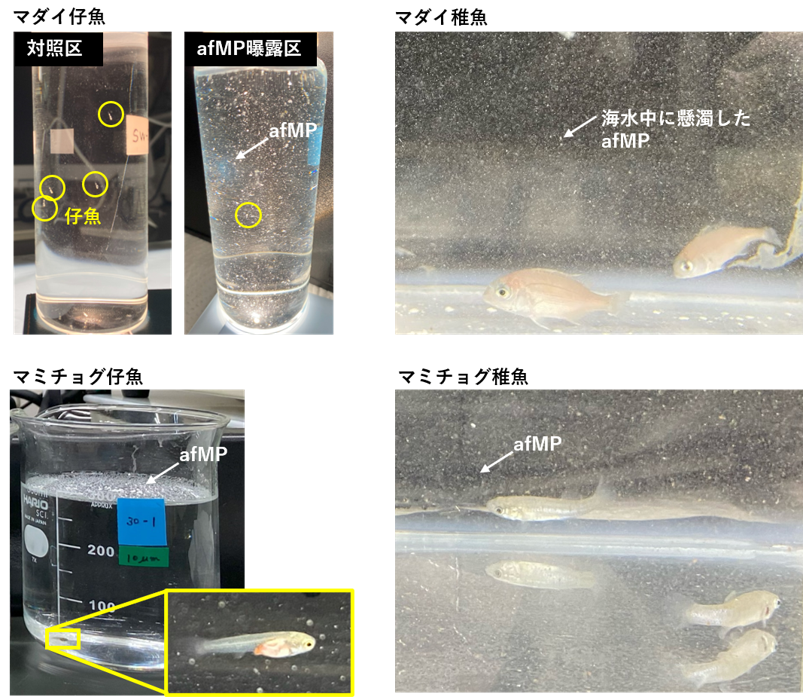
粒径の異なる3種類のマイクロプラスチック(afMP)の影響を調べた飼育試験中の魚の様子。
水中に浮かぶ白い懸濁物がafMP。出典:https://www.fra.go.jp/home/kenkyushokai/ronbun/2026/20260801_kataoka.html
<関連情報>
- https://www.fra.go.jp/home/kenkyushokai/ronbun/2026/20260801_kataoka.html
- https://www.sciencedirect.com/science/article/abs/pii/S0025326X26009914
紫外線劣化・破砕した3種類の粒径のポリエチレンマイクロプラスチックは、標準化毒性試験において2種の海産硬骨魚類の生活史特性に悪影響を及ぼさない
No adverse effects of three size classes of UV-aged and fragmented polyethylene microplastics on life-history traits of two marine teleost fish species in standardized toxicity tests
Chisato Kataoka, Md. Khorshed Alam, Nobuyuki Ohkubo, Katsutoshi Ito, Masahiro Hayashi, Daniel Christian Wijaya, Seokhyun Lee, Yuji Oshima, Takeshi Hano
Marine Pollution Bulletin 233, Part 1, Article 120204 (December 2026):2026-8-1
DOI:https://doi.org/10.1016/j.marpolbul.2026.120204
Microplastics in marine environments undergo ultraviolet (UV) weathering and fragmentation, which alter their size and surface properties. This study evaluated the effects of environmentally relevant, UV-aged polyethylene (PE) microplastics on early life stages of marine fish. Additive-free PE was UV-aged and fragmented into three size classes (10, 30, and 100 µm), and tested on red seabream (Pagrus major) and mummichog (Fundulus heteroclitus) embryos, larvae, and juveniles. Exposure concentrations were based on a projected future marine concentration of 1 mg/L, with the highest concentration reaching 30 times that level. Standardized OECD test guidelines and Whole Effluent Toxicity (WET) protocols were used to assess survival and growth. No detectable adverse effects on either endpoint were observed across the tested species, life stages, particle sizes, or concentrations. These findings suggest that, under dispersant-free exposure conditions, UV-aged PE microplastics may have limited organism-level effects on the early life stages of these fish. Further studies are needed to assess other plastic types, additives, and combined environmental stressors.