2026-11-17 中国科学院(CAS)
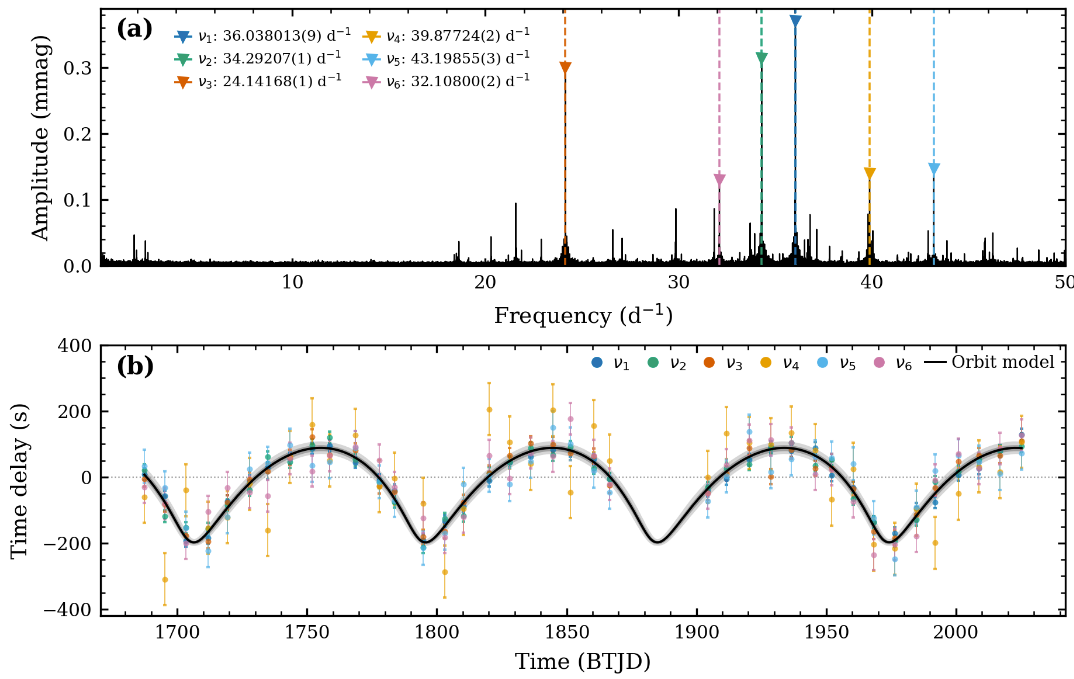
Pulsation spectrum and orbital timing measurements of TIC 160582982, revealing an orbital period of 89.29 days. (Image by LV Chenglong)
<関連情報>
- https://english.cas.cn/newsroom/research-news/202611/t20261117_1219675.shtml
- https://iopscience.iop.org/article/10.3847/1538-4357/aea560
δ Scuti型変光星TIC 160582982における大質量の未確認伴星の星震学的検出
(Asteroseismic Detection of a Massive Unseen Companion to the δ Scuti Star TIC 160582982)
Chenglong Lv, J. Pascual-Granado, Ali Esamdin, Angela Gardini, Haozhi Wang, Jianwei Yao, Shuguo Ma.
The Astrophysical Journal, 1010, 199 (2026).
DOI: https://doi.org/10.3847/1538-4357/aea560
δ Scuti型変光星TIC 160582982の脈動を精密に解析し、その周囲に存在する大質量の未確認伴星を検出した。研究チームは、6つの安定した高周波振動モードを利用した位相変調解析と、独立した周波数変調解析により、連星の公転周期が89.29日、軌道離心率が0.539であることを明らかにした。伴星の最小質量は太陽の約1.80倍と推定されたが、測光・分光観測では明るい伴星の存在を示す明確な証拠は得られなかった。この結果は、伴星が中性子星や恒星質量ブラックホールなどのコンパクト天体である可能性を示唆している。本研究は、恒星の脈動を精密な時計として利用することで、降着現象などの明確な光学的兆候を示さない大質量コンパクト天体を探査できる可能性を示した。
This study reports the asteroseismic detection of a massive unseen companion to the δ Scuti star TIC 160582982. The researchers used six coherent high-frequency pressure modes as pulsation clocks and analyzed their phase variations to determine the binary orbit. They derived an orbital period of 89.29 days and an eccentricity of 0.539. The mass function indicates a minimum companion mass of approximately 1.80 solar masses. However, neither photometric nor spectroscopic observations revealed clear evidence of a luminous companion. This suggests that the unseen object may be a compact object, such as a neutron star or a stellar-mass black hole. The study demonstrates the potential of stellar pulsation timing for identifying massive compact objects that lack obvious accretion signatures. Further high-resolution, phase-resolved spectroscopy will be important for independently constraining the orbit and determining the nature of the companion.
原著論文:https://iopscience.iop.org/article/10.3847/1538-4357/aea560