2026-11-06 中国科学院(CAS)
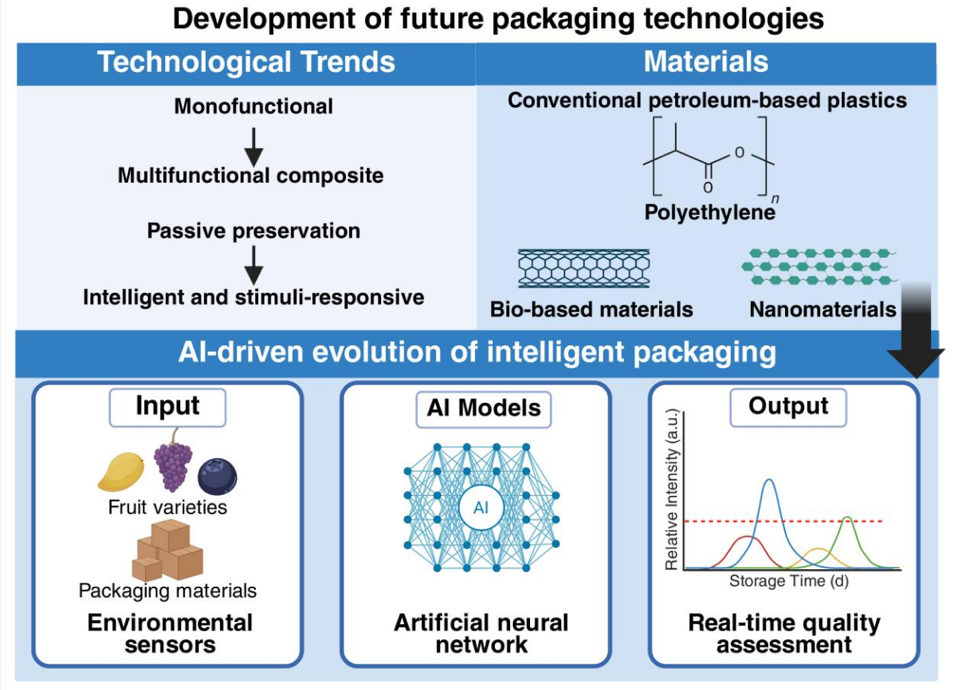
Future directions for functional packaging technologies. (Image by ZHU Hong)
<関連情報>
- https://english.cas.cn/newsroom/research-news/202611/t20261106_1213342.shtml
- https://ift.onlinelibrary.wiley.com/doi/10.1111/1541-4337.70671
収穫後果実保存のための高度な機能性包装戦略:生理学的調節からインテリジェントなモニタリングまで Advanced Functional Packaging Strategies for Postharvest Fruit Preservation: From Physiological Regulation to Intelligent Monitoring
Yuci Li, Linrui Zhong, Dandan Zhang, Xiangjin Kong, Yueming Jiang, Liang Gong, Hong Zhu
Comprehensive Reviews in Food Science and Food Safety Published: 22 October 2026
DOI:https://doi.org/10.1111/1541-4337.70671
Abstract
Postharvest fruits are highly susceptible to rapid senescence and microbial decay, a process primarily driven by intense respiration and endogenous ethylene signaling. While conventional packaging provides basic physical protection, the shift towards multi-component functional interfaces offers dynamic solutions for physiological regulation. This review provides a critical analysis of advanced functional packaging strategies, focusing on the synergistic integration of natural biopolymers, deep eutectic solvents (DESs), and nanoporous structures. We dissect the intrinsic mechanisms by which these materials modulate the microenvironment dynamics, particularly the precise control of O2/CO2/C2H4 fluxes and moisture migration, and their impact on fruit oxidative stress markers and metabolic pathways. Furthermore, we evaluate the feasibility of transitioning from passive barriers to stimulus-responsive intelligent systems, highlighting the convergence of flexible sensors, radio frequency identification (RFID) data acquisition, and machine-learning models that together enable real-time quality monitoring throughout the supply chain. Finally, we analyze the trade-off between the large-scale application of bio-based materials and the precision of active ingredient release, and further highlight how divergent regulatory frameworks for food-contact materials in major markets (e.g., the European Union, the United States, and China) constrain industrial application. Based on the collaborative assessment of the above-mentioned technical and institutional bottlenecks, differentiated breakthrough paths have been discussed to provide a roadmap for the development of sustainable, high-performance preservation technologies after harvest.