
2026-11-04 東北大学
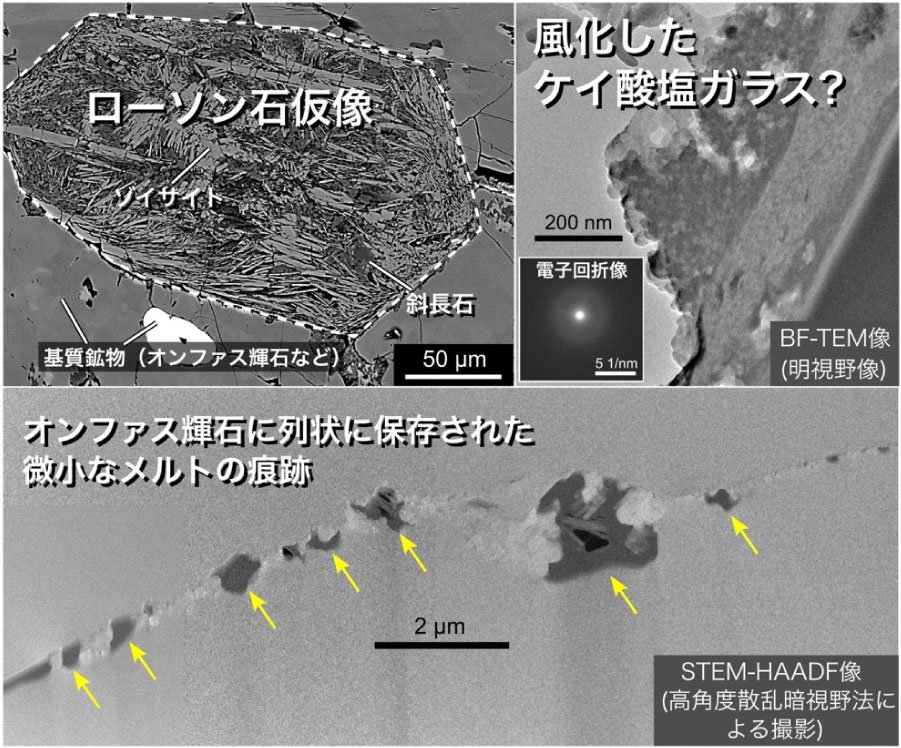
図1. コロラド高原産エクロジャイト捕獲岩から発見された、ローソン石の分解と岩石の融解を示した微細組織。TEMを使用した微小領域の観察により、ローソン石仮像(上段)およびオンファス輝石(下段)からメルトの急冷組織を発見した。
<関連情報>
- https://www.tohoku.ac.jp/japanese/2026/11/press20261104-02-lawsonite.html
- https://academic.oup.com/petrology/article-abstract/67/10/egag092/8913147
コロラド高原におけるローソナイトエクロジャイト捕獲岩の融解:漸新世の熱パルスに関する微細岩石学的制約 Melting of a Lawsonite Eclogite Xenolith in the Colorado Plateau: Micropetrological Constraints on the Oligocene Thermal Pulse
Ryo Fukushima , Tatsuki Tsujimori , Nobuyoshi Miyajima , Sayako Inoué , Tiziana Boffa-Ballaran , Giacomo Criniti
Journal of Petrology Published: 13 October 2026
DOI:https://doi.org/10.1093/petrology/egag092
Abstract
The Navajo Volcanic Field in the Colorado Plateau (southwestern USA) is the only locality in the world where slab-derived high-pressure metamorphic rocks have been rapidly brought to the surface as xenoliths. As those xenoliths occur within serpentinized ultramafic microbreccias, they are interpreted to have been transported by an enormous explosion of the hydrated lithospheric mantle, rather than directly by deep-sourced magma. However, some xenoliths preserve evidence of a thermal pulse related to Oligocene Farallon slab tearing. Here, we examine records of the Oligocene thermal pulse in a lawsonite (pseudomorph)-eclogite xenolith with petrological characterization and crystallographic analysis. Garnet porphyroblasts in the xenolith record metasomatic overprinting by Mg-rich domains, and garnet cores were replaced by omphacite. These features suggest eclogite-facies metasomatism similar to those proposed in previous studies. However, omphacite has cation-disordered structure, and quenched felsic melt pockets of trondhjemitic to granitic composition are found as an array in omphacite, indicating that the xenolith was heated above 800 °C after eclogite formation. Lawsonite pseudomorphs are basically composed of euhedral zoisite, euhedral mica (~pg50 marg50), anhedral to subhedral plagioclase (~ab75 an25), and altered silicate glass. Omphacite grains enclosed in lawsonite pseudomorphs have zoisite-free halos in which peritectic aspidolite preferentially occurs. These observations suggest the past presence of hydrous silicate melt in lawsonite pseudomorphs and its crystallization at sufficiently low-P conditions at which plagioclase is stable. Multicomponent diffusion modeling of the metasomatized garnet constrains a short heating timescale to <104 years, but probably <10 years if directly interacted with a deep-sourced magma. Taken together, we argue that a transient magmatic episode first transported the eclogitized slab fragments into a shallower level (<60 km) in the subcontinental lithospheric mantle or overlying crust, which caused rapid heating, local flux melting, dehydration melting of lawsonite, and quenching to subsolidus temperatures. The xenolith then experienced the final explosive emplacement either immediately or after some period of subsurface storage.

