2026-10-22 中国科学院(CAS)
<関連情報>
- https://english.cas.cn/newsroom/research-news/202610/t20261020_1209199.shtml
- https://www.nature.com/articles/s41586-026-11183-2
空間的閉じ込めを調整することに基づくゼオライト触媒によるオレフィンカルボニル化 Zeolite-catalysed olefin carbonylation based on tuning spatial confinement
Liang Qi, Yingying Sheng, Wenna Zhang, Youming Ni, Linhai He, Bin Li, Anjie Wang, Wenliang Zhu, Alexis T. Bell & Zhongmin Liu
Nature Published:21 October 2026
DOI:https://doi.org/10.1038/s41586-026-11183-2
Abstract
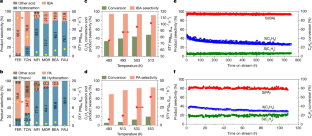
Carbonylation is an important process used to produce aldehydes, carboxylic acids and esters1,2,3,4,5 that is usually catalysed by homogeneous metal complexes with ligands and iodide promoters6,7,8,9,10,11,12. Koch has reported that protons of mineral acids can also catalyse carbonylation13. Previous studies have demonstrated that Brønsted acidic zeolites can act as a heterogeneous, Koch-type catalyst for carbonylation of alcohols and olefins, but the products in this case are limited to tertiary carboxylic acids14,15,16,17,18. Here we show that targeted use of spatial confinement in a zeolite together with a high CO/olefin ratio can help break this limitation. We report that, with FER zeolite and a CO/olefin ratio of 360, olefin carbonylation can produce primary and secondary carboxylic acids as the main products; ethylene carbonylation to propanoic acid (PA) is achieved with 80% selectivity over 100 h and propylene carbonylation to isobutyric acid (IBA) is achieved with 95% selectivity over 750 h. The propylene and ethylene carbonylation selectivities decrease to 61% and 57%, respectively, as the CO/olefin ratio decreases to 24 and 90, respectively. Experiments in combination with theoretical calculations suggest that T2-O5 in eight-membered ring (8-MR) cavities of FER zeolite are the primary active sites for ethylene carbonylation and T3-O1 in ten-membered rings (10-MRs) are the primary active sites for propylene carbonylation. Our findings open new directions for olefin carbonylation and provide critical insights into the prerequisites for developing new zeolite-based carbonylation processes.