2026-10-18 マサチューセッツ工科大学(MIT)
<関連情報>
- https://news.mit.edu/2026/giving-ai-crystal-clear-view-of-materials-world-1018
- https://www.nature.com/articles/s41467-026-76378-7
合成物語を用いたマルチモーダル素材表現学習のスケーリング Scaling multimodal materials representation learning with synthetic narratives
Yang Jeong Park, Mayank Kumaran, Chia-Wei Hsu, Elsa Olivetti & Ju Li
Nature Communications Published:26 August 2026
DOI:https://doi.org/10.1038/s41467-026-76378-7
Abstract
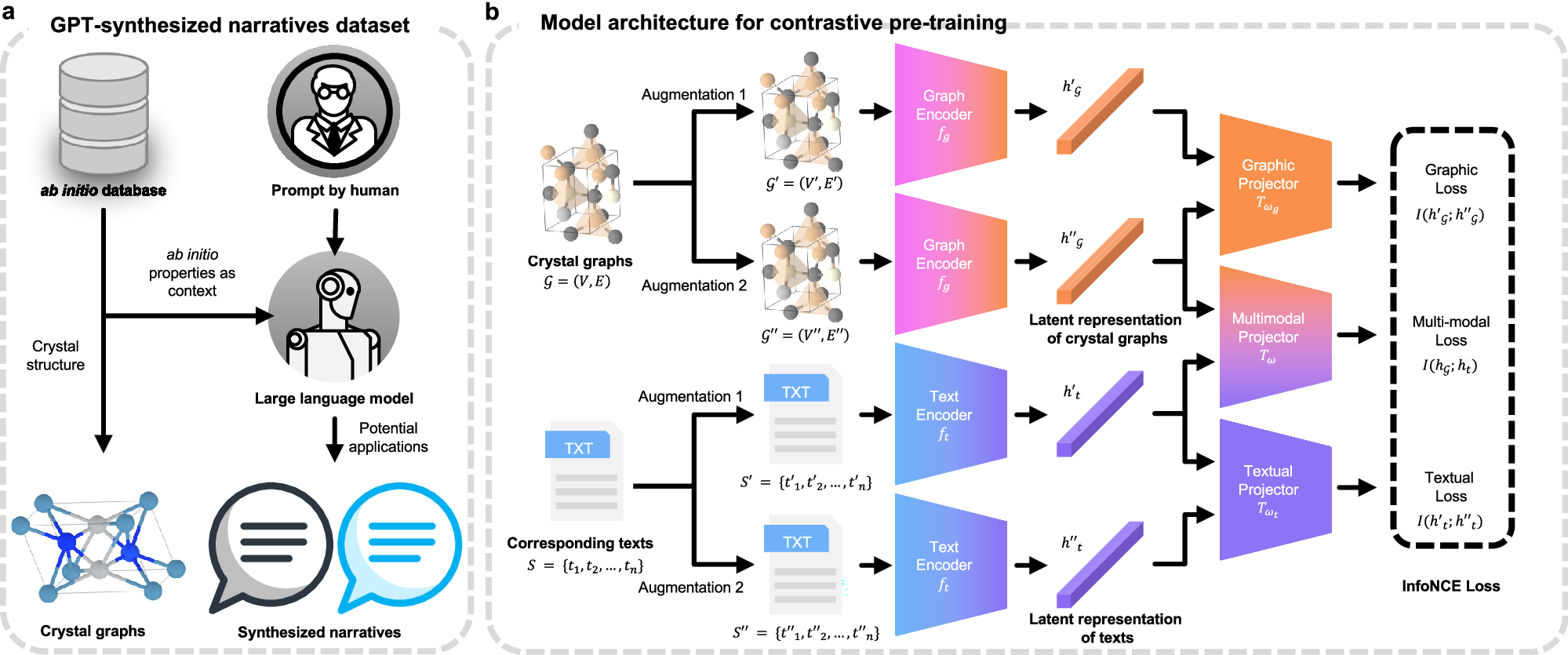
Artificial intelligence is increasingly applied to inverse materials design, including crystals and molecules. For molecular systems, multimodal models that integrate chemical structures with natural language have enabled flexible, instruction-driven reasoning. However, approaches for crystalline materials remain limited by the scarcity and imbalanced bias of available crystal datasets and the weak semantic supervision provided by peer-reviewed literature. We introduce a contrastive language-crystals model (CLaC), a multimodal contrastive learning framework that aligns crystal structures with natural language, pre-trained on property-conditioned synthetic narratives of crystal structure-text pairs generated by language models. Here we show that, compared with models trained on literature-derived text, this property-grounded synthetic supervision enables semantic alignment unachievable with existing academic corpora. Embedding-space analyses reveal structured associations between language and crystal structures. These results establish a foundation for zero-shot, instruction-driven reasoning in crystalline materials.