
2026-10-05 デルフト工科大学(TU Delft)
<関連情報>
- https://www.tudelft.nl/en/2026/me/news/new-metamaterial-design-recreates-one-of-natures-toughest-connections
- https://www.nature.com/articles/s41467-026-77560-7
多孔質支柱と三重周期最小曲面格子構造のハイブリッド接続戦略 Strategy for hybrid connection of porous strut and triply periodic minimal surface lattice structures
Jianxing Yang, Vahid Moosabeiki, Long Bai, Mauricio Cruz Saldívar, Marius A. Leeflang, Xiaohong Chen, Amir A. Zadpoor & Mohammad J. Mirzaali
Nature Communications Published:05 October 2026
DOI:https://doi.org/10.1038/s41467-026-77560-7
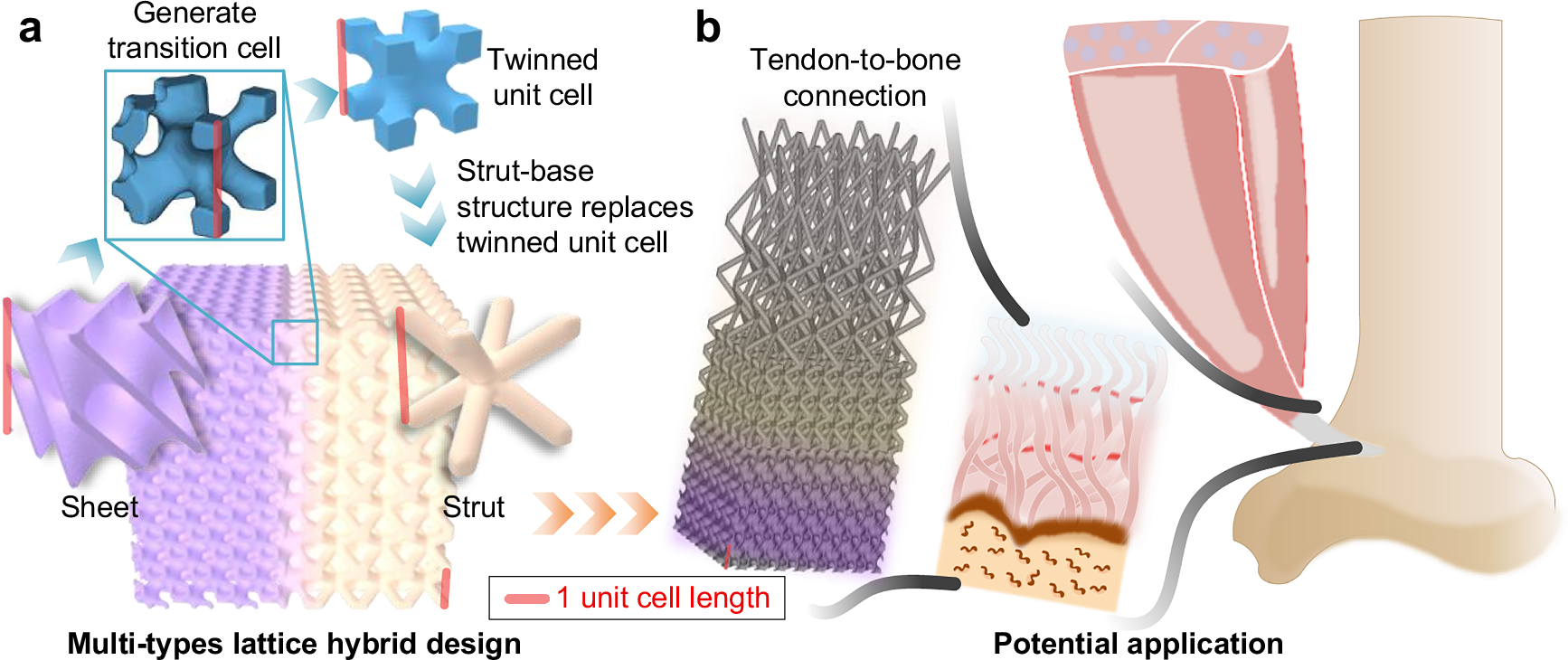
Abstract
Hybrid design approaches are essential for developing porous lattice structures with integrated multifunctional performance. While previous studies have focused on hybridization among different topologies, combining distinct structure types—such as integrating the high mechanical strength of triply periodic minimal surface (TPMS) sheet structures with the meta-structural characteristics of strut-based architectures—remains underexplored due to challenges in creating effective connections between these disparate forms. Here, we introduce a design strategy for hybridizing TPMS sheet and strut lattice structures via twinned unit cells. These transition substructures have tunable properties enabling modulation of the transition cell modulus from 0.4 to 5 times its original value and direct generation of 3D-printable files. This approach enables a more effective balance between multiple mechanical properties. Prototypes demonstrate successful hybridization and multifunctional performance, achieving both geometric and mechanical compatibility. Notably, the hybrid structures exhibit a 37- to 84-fold variation in structural stiffness, addressing complex requirements, such as bone-to-tendon interfaces, that are challenging for previously reported strategies.
