
2026-10-02 大阪大学,量子科学技術研究開発機構,台湾国立中央大学
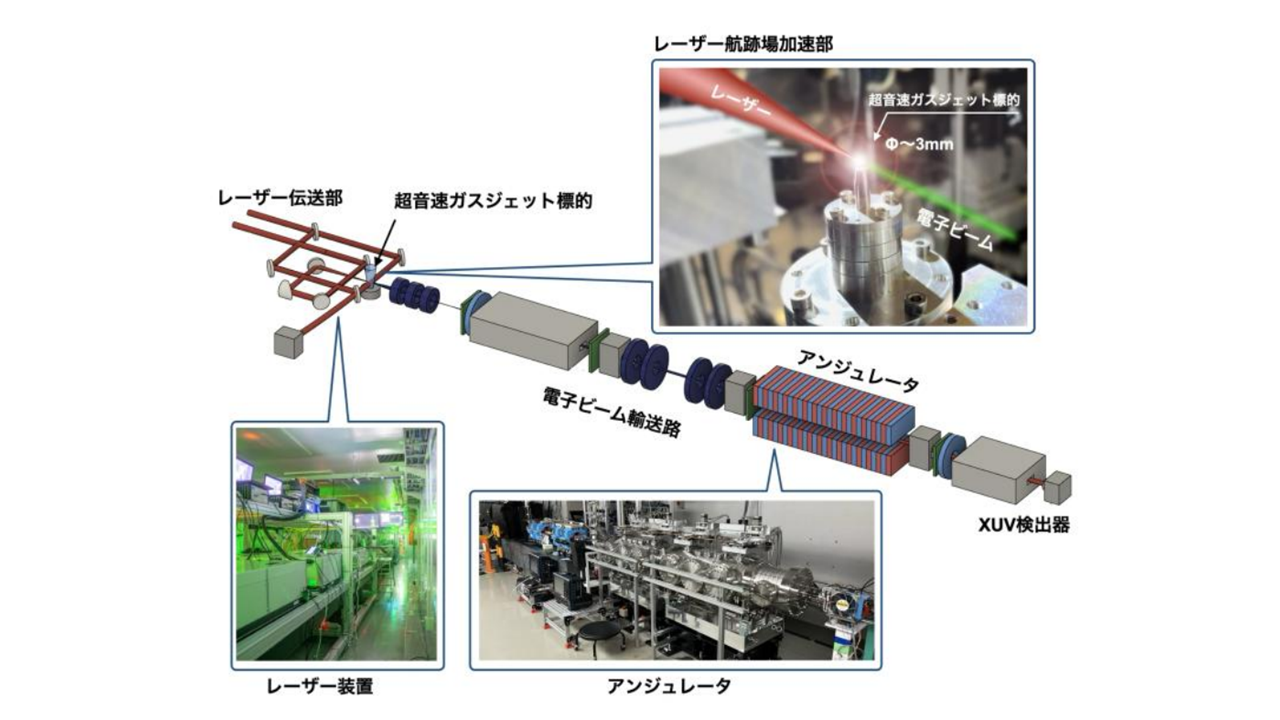
図1.本研究の実験配置および検出された陽子のエネルギー分布。
<関連情報>
- https://www.qst.go.jp/site/press/20261002.html
- https://academic.oup.com/ptep/article/2026/10/103J01/8857699
大面積懸架グラフェンへの高強度レーザー照射によって誘起される伝播静電波を介した陽子サーフィン加速 Proton Surfing Acceleration via Propagating Electrostatic Waves Induced by Intense Laser Irradiation on Large-Area Suspended Graphene
Takumi Minami, Che-Men Chu, Kentaro Sakai, Tomoya Taguchi, Takamasa Hihara, Naoya Tamaki, Soichiro Suzuki, Fuka Nikaido, Yuki Abe, Hideaki Habara, …
Progress of Theoretical and Experimental Physics Published:02 October 2026
DOI:https://doi.org/10.1093/ptep/ptag130
Abstract
Generating 100-MeV protons is pivotal to developing laser-driven ion sources for many applications that range from medicine to laboratory astrophysics. An ultra-thin target is a way to increase the ion energy; however, such a target is easily destroyed by the interaction with laser prepulses. We have developed a large-area suspended graphene (LSG) target and demonstrated its durability by generating energetic protons and carbons by irradiating the thinnest target ever (2 nm) with an ultra-intense laser without a plasma mirror. Here, we show the experimental results of proton energies reaching 132 MeV by optimizing the laser conditions for the ultra-thin LSG targets. Ion diagnostics were primarily performed using a CR-39 stack detector combined with machine-learning-assisted analysis. Numerical simulations support the experimental results, where the radiation pressure of a relatively long-duration, low-intensity laser pulse slowly pushes the plasma, leading to the formation of a propagating electrostatic wave that efficiently accelerates protons, as in surfing acceleration.
