2026-10-01 北海道大学
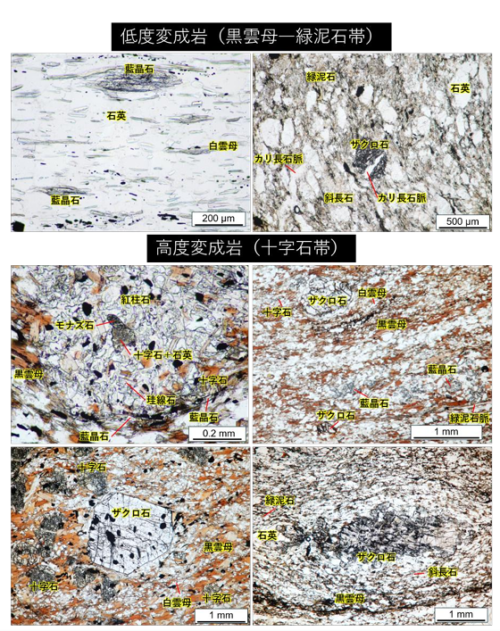
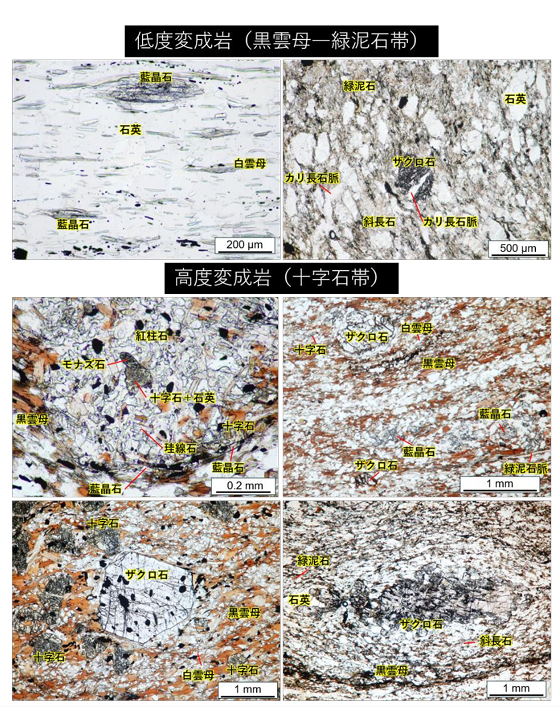
(上)細粒~中粒の低度変成岩2分析試料の顕微鏡写真 (下)中粒~粗粒の高度変成岩4分析試料の顕微鏡写真
<関連情報>
- https://www.hokudai.ac.jp/news/2026/10/post-2457.html
- https://www.hokudai.ac.jp/news/pdf/261001_pr3.pdf
- https://www.sciencedirect.com/science/article/abs/pii/S1367912026003433
ベトナムチョン・ソン帯南部ア・ブオン層の変成進化と砕屑物供給源:カテイシア岩体とのテクトニックな関連性と前期デボン紀変成作用の示唆 Metamorphic evolution and detrital provenance of the A Vuong Formation, Southern Truong Son Belt, Vietnam: implications for the tectonic affinity of the Cathaysia Block and Early Devonian metamorphism
Vuong Bui Thi Sinh, Ippei Kitano, Anh Tran Tuan
Journal of Asian Earth Sciences Available online: 31 August 2026
DOI:https://doi.org/10.1016/j.jseaes.2026.107290
Highlights
- Staurolite zone schists record the peak metamorphism at around 600 °C and 7–9 kbar.
- Anti-clockwise P–T paths from 30–40 °C/km to 20–25 °C/km geotherms were deduced.
- Detrital zircon ages are equivalent to the Cambrian strata of the Cathaysia Block.
- Metamorphism locally occurred at Early Devonian through the arc accretion–collision.
- Minor hydrothermal event overprinted by the Triassic Indosinian orogeny.
Abstract
Tectonic background of Early Paleozoic thermal events recorded in the Indochina Block, which plays a role for the reconstruction of its tectonic evolution before Asian continent assembly, remains in controversy such as continental collision tectonics vs. subduction-related arc tectonics. The A Vuong Formation (AVF) in the Truong Son Belt, central Vietnam, adjacent to the Silurian granitoid complex, Dai Loc Complex (DLC), preserves poorly-studied metamorphic rocks of which metamorphic evolution and detrital provenance have potential to give a crucial constraint on the tectonometamorphic history during the Early Paleozoic at the eastern margin of the Indochina Block. Petrographic, mineral chemical, thermobarometric and U(–Th)–Pb geochronological studies were conducted on pelitic and siliceous schists of the AVF’s biotite–chlorite and staurolite zones, greenschist and lower amphibolite facies respectively. Thermobarometric results indicate that the staurolite zone schists experienced an anti-clockwise pressure (P)–temperature (T) path, with geothermal gradients decreasing from ca. 30–40 °C/km during the prograde metamorphism to 20–25 °C/km at peak conditions. U–Th–Pb dating of monazites constrains medium P/T amphibolite-facies metamorphism to 410–400 Ma (Early Devonian), followed by minor low T (<400 °C) hydrothermal alteration during the Triassic. Detrital zircon spectra, with the youngest grain at ca. 540 Ma and major peaks at ca. 1100, 950 and 700 Ma, are comparable with that of Cambrian sequence of the Cathaysia Block derived from Precambrian terranes in the India–Antarctica portion of East Gondwana. The Barrovian-type Devonian metamorphic event that affected the AVF possibly occurred in response to heat provided by the accretion–collision of the DLC volcanic arc, suggesting that the two were tectonically linked in Early Devonian. Such new insights likely fit the subduction and island arc system during the pre-Devonian thermal events in the DLC, eastern Indochina Block.