

2026-09-30 東京科学大学
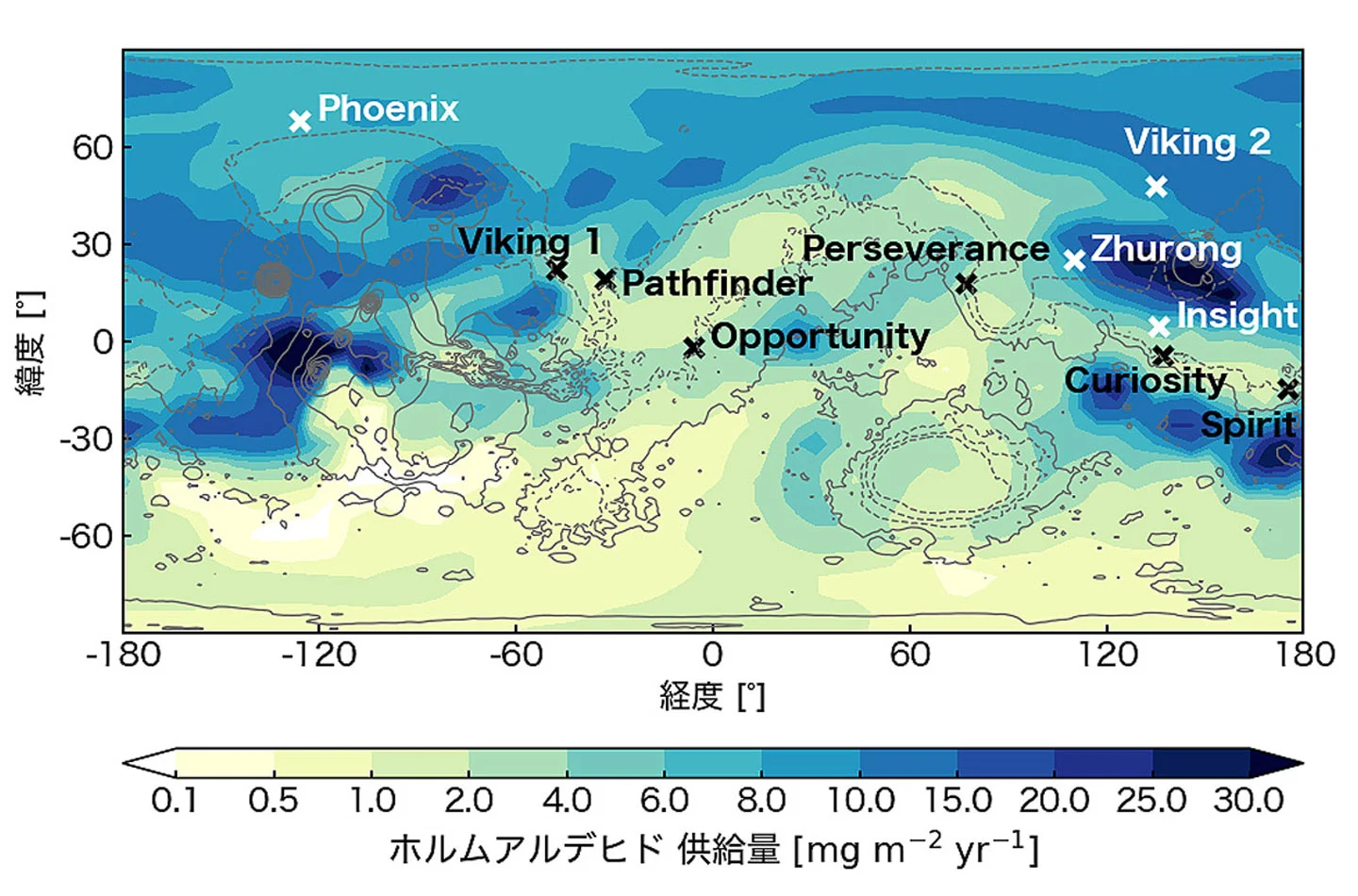
図1. 太古火星における大気ホルムアルデヒドの地表供給量分布
<関連情報>
温暖な初期火星における大気中のホルムアルデヒド沈着の地球規模分布と水蒸気との相関関係 Global Distribution of Atmospheric Formaldehyde Deposition Correlated with Water Vapor on a Warm Early Mars
Shungo Koyama, Arihiro Kamada, Naoki Terada, Yoshihiro Furukawa, Tatsuya Yoshida, Yuki Nakamura, Takeshi Kuroda, Ann Carine Vandaele and Shohei Aoki
The Planetary Science Journal Published: 2026 September 30
DOI:10.3847/PSJ/ae9942
Abstract
On early Mars, transient warm periods during the late Noachian and early Hesperian were likely triggered by episodic inputs of reducing greenhouse gases, such as H2. In such a weakly reducing atmosphere, formaldehyde (H2CO), a precursor for the abiotic formation of sugars via the formose reaction, can be effectively produced. While this pathway is a candidate source for Martian organic matter, previous 1D photochemical modeling could not predict the spatial distribution of organic synthesis. In this study, we developed a lookup table of H2CO production based on key atmospheric variables using a photochemical model and coupled it with a global climate model. We calculated the global distribution of the atmospheric deposition fluxes of H2CO under a 2 bar CO2 atmosphere containing 6% H2 with obliquity of 40°. Our results reveal a strong positive correlation between atmospheric H2CO deposition and H2O vapor abundance, driven by both the enhanced photochemical production of H2CO through H2O photolysis and the efficient scavenging by precipitation in humid regions. Significant atmospheric deposition of H2CO is observed over water bodies, including the northern ocean. Furthermore, atmospheric deposition hotspots emerge around topographic highs, such as the Tharsis and Elysium mons, due to orographic precipitation. We suggest that basins adjacent to persistently humid regions, which likely experienced H2CO accumulation and subsequent organic synthesis, could be potential landing sites for future missions to investigate ancient chemical evolution and whether it led to the origin of life.
](https://tiisys.com/wp-content/uploads/2026/10/スクリーンショット-2026-10-01-160947.png "個人セスナ172Mラムの事故[着陸時の機体損傷](福井県坂井市 福井空港、令和7年10月9日発生)")