2026-09-21 NASA
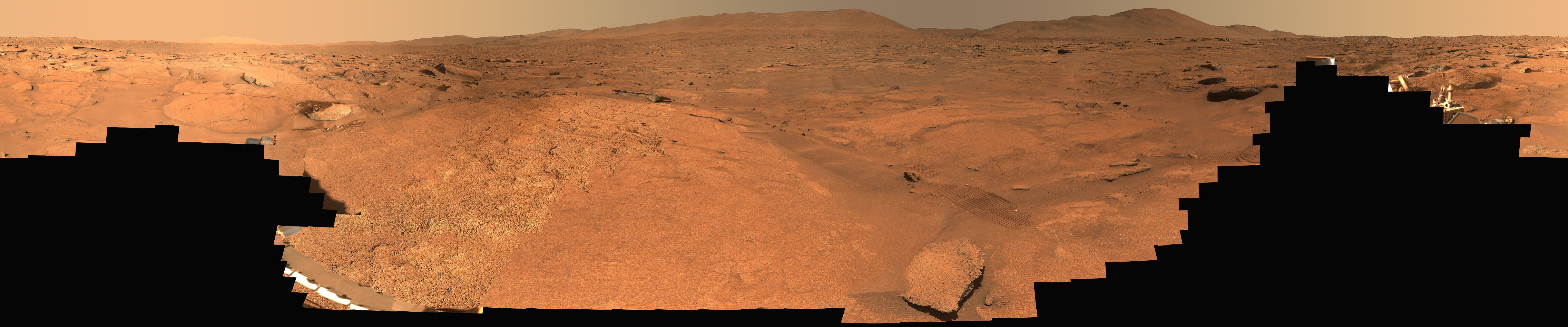
The Perseverance rover captured the data used in this panorama of the “Margin Unit,” a geologic area that hugs the inner edge of Jezero Crater’s rim, between Oct. 8 and Oct. 16, 2023. NASA/JPL-Caltech/MSSS
<関連情報>
- https://www.nasa.gov/solar-system/planets/mars/nasa-discovery-reveals-complex-water-systems-on-early-mars/
- https://www.nature.com/articles/s43247-026-03997-9
火星ジェゼロ・クレーターのカンラン石を豊富に含むマージン層の、湖水および地下水に関連した変質 Lake- and groundwater-associated alteration of the olivine-rich Margin unit in Jezero crater, Mars
Candice C. Bedford, Eleni Ravanis, Roger C. Wiens, Elise Clavé, Julene Aramendia, Juan Manuel Madariaga, Eleanor Moreland, Stephanie Connell, Alexander Jones, Briony Horgan, Olivier Forni, Bradley Garczynski, Susanne Schröder, Kenneth Williford, Linda Kah, Kathryn Stack, Lucia Mandon, Agnés Cousin, Pierre Beck, Erwin Dehouck, Clément Royer & Adrian Brown
Communications Earth & Environment Published:21 September 2026
DOI:https://doi.org/10.1038/s43247-026-03997-9
Abstract
The Margin unit in Jezero crater, Mars, was explored by NASA’s Perseverance rover as orbital data suggested it may represent an ancient lake shoreline. Using SuperCam data, we evaluate the origin and alteration history of this enigmatic unit. Here, we show that the Margin unit explored at high elevations (>−2350 m) has a texture and chemistry indicative of a slow-cooled, crystalline, olivine-rich rock without significant water exposure. In contrast, exposures situated below the hypothesized Jezero paleolake’s second terrace level reveal a complex history of water-rock interaction, with signs of physical reworking near Neretva Vallis and the Western fan. We identify three main alteration episodes: first, neutral-to-alkaline CO2-rich fluids circulated within the bedrock, forming carbonate-rich ridges upon erosion. Then, exposure to the Jezero paleolake waters or changes in groundwater fluids remobilized carbonate and precipitated silica in the secondary pore spaces. Finally, late-stage hydrothermal fluids flowed through younger fractures, precipitating fluorite-bearing, Ca-sulfate mineral veins. This sequence of multiple fluid events driven by groundwater activity and exposure to the lake reinforces the Margin unit as a locality of astrobiological interest.