2026-09-21 合肥物質科学研究院(HFIPS)
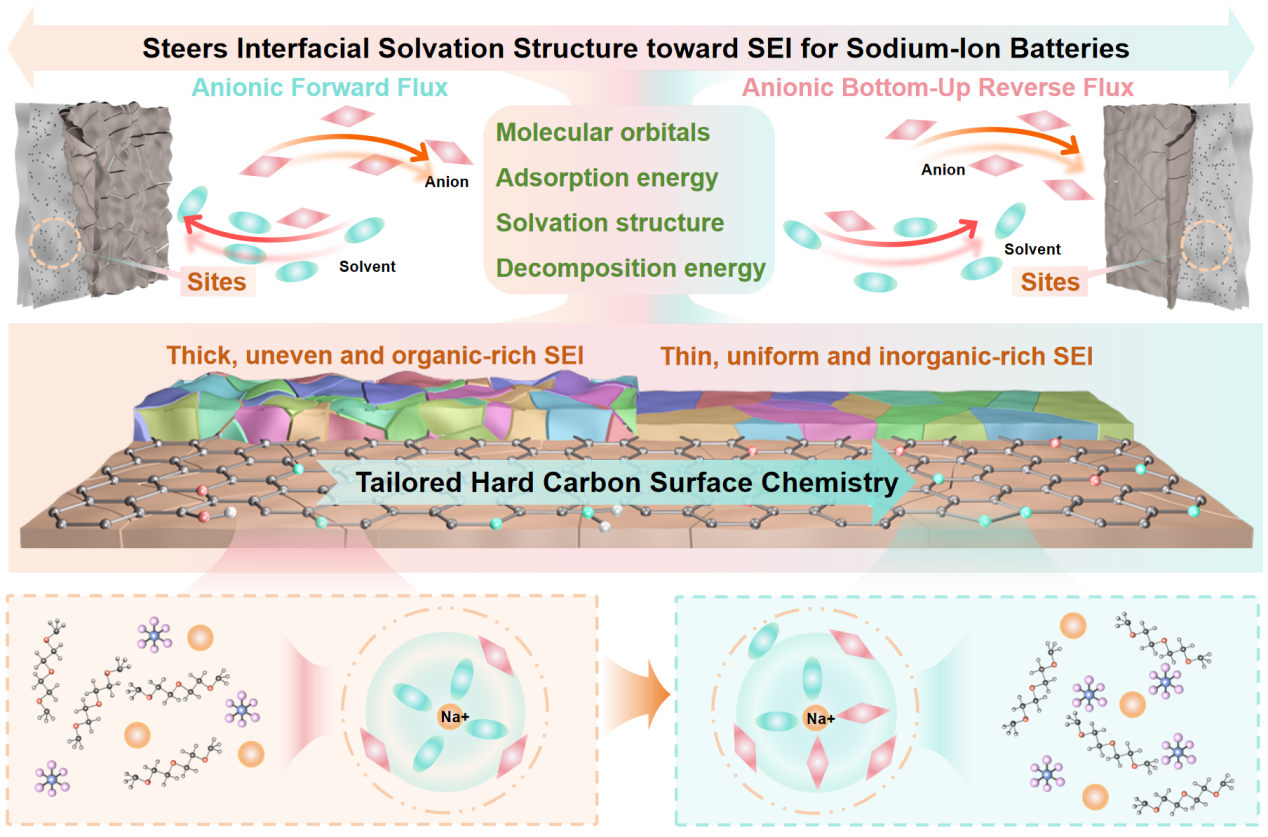
Anionic bottom-up reverse flux for steering interfacial solvation structure by molecular-level surface design. (Image by WANG Peiyao)
<関連情報>
- https://english.hf.cas.cn/nr/rn/202609/t20260921_1200951.html
- https://link.springer.com/article/10.1007/s40820-026-02339-w
硬質炭素表面化学を介した陰イオンボトムアップフラックス制御による安定なナトリウムイオン電池 Anionic Bottom-Up Flux Orchestrated via Hard Carbon Surface Chemistry for Stable Sodium-Ion Batteries
Peiyao Wang, Shendong Xu, Siya Wang, Xiaoyu Cui, Jin Bai, Yuping Sun, Xuebin Zhu, Bangchuan Zhao, Shulei Chou & Xingqiao Wu
Nano-Micro Letters Published:03 September 2026
DOI:https://doi.org/10.1007/s40820-026-02339-w
Highlights
- A cooperative pair of pyridinic-N and carbonyl groups creates a trap-and-repel microenvironment that actively programs interfacial reactions.
- The functional differentiation drives a sustained bottom-up anionic flux, steering decomposition toward an anion-derived pathway.
- The resulting inorganic-rich solid-electrolyte interphase enables 91.9% initial Coulombic efficiency and 96.5% capacity retention over 5,000 cycles.
Abstract
Hard carbon anodes for sodium-ion batteries suffer from unstable solid-electrolyte interphase formation, leading to low initial Coulombic efficiency and poor cycle stability. Herein, we demonstrate a molecular-level surface design that actively orchestrates an anionic bottom-up flux from the electrolyte bulk to the hard carbon interface. By engineering a synergistic pair of pyridinic-N and carbonyl groups on the carbon surface, we create a functional-differentiation microenvironment where pyridinic-N selectively anchors PF6− anions, while the cooperative carbonyl repels solvent molecules. This dual functionality establishes a sustained concentration gradient that drives a continuous reverse flux of anions toward the interface, fundamentally redirecting the electrolyte decomposition pathway from solvent-dominated to anion-preferential. The tailored surface lowers the PF6− decomposition barrier by over 70%, yielding a thin, inorganic-rich solid-electrolyte interphase dominated by NaF and Na2O. The optimized anode achieves 91.9% Coulombic efficiency with high reversible capacity of 368.2 mAh g−1, and 96.5% capacity retention after 5,000 cycles. A pouch cell assembled with NFPP cathode achieves an energy density of 239.1 Wh kg−1 and stable operation over 500 cycles, demonstrating strong practical potential. This work establishes active surface-guided anionic transport as a powerful strategy for interphase engineering in advanced sodium-ion batteries.