2026-09-17 国立天文台
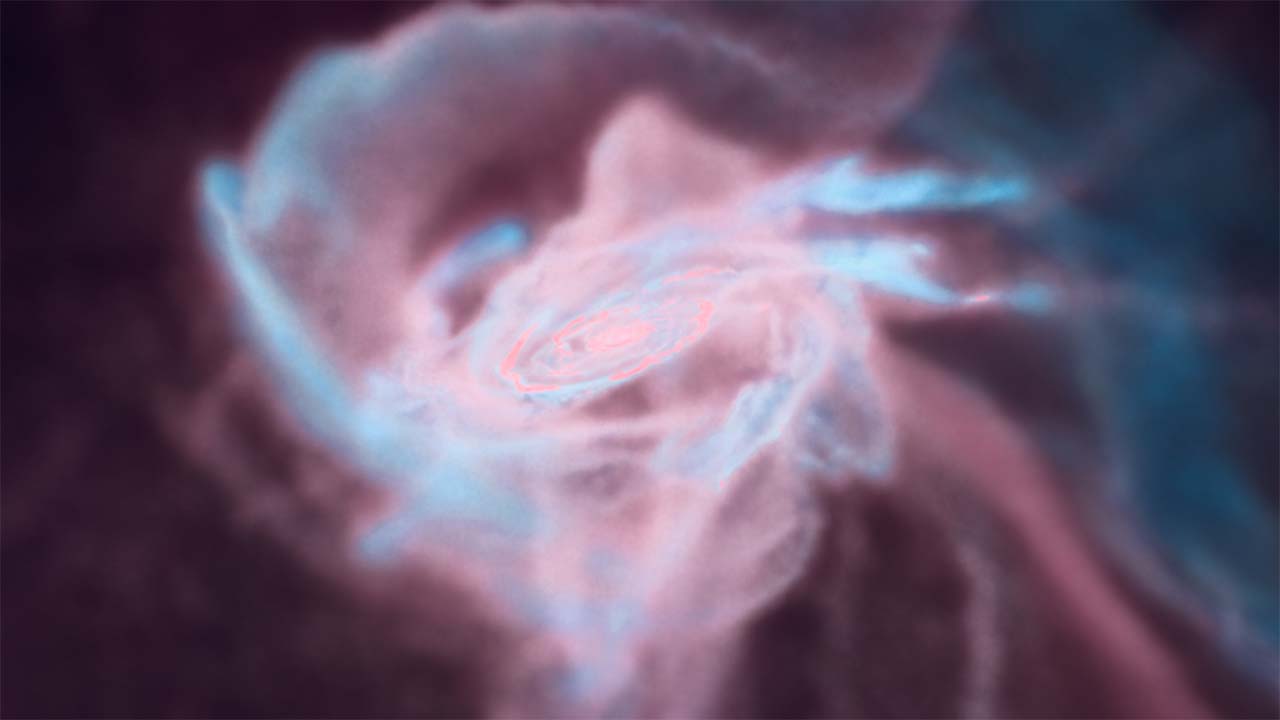
アテルイIIIによるシミュレーションで描き出した、ガスに包まれたブラックホールが急成長する姿。温度が高い場所ほど赤く色付けされている。(クレジット: 鄭昇明、武田隆顕、国立天文台4次元デジタル宇宙プロジェクト)
<関連情報>
- https://www.nao.ac.jp/news/science/2026/20260917-cfca.html
- https://www.nature.com/articles/s41586-026-10985-8
シミュレーションでは、超大質量ブラックホールや小さな赤い点が自然に形成される Overmassive black holes and little red dots naturally form in simulations
Sunmyon Chon,Shingo Hirano,Tomoaki Ishiyama,Seok-Jun Chang & Volker Springe
Nature Published:16 September 2026
DOI:https://doi.org/10.1038/s41586-026-10985-8
Abstract
The origin of supermassive black holes remains a long-standing problem in astrophysics. Recent James Webb Space Telescope (JWST) observations reveal an unexpectedly abundant population of overmassive black holes at z > 4–6, at which the black hole masses lie far above local scaling relations and are not reproduced by present cosmological models1,2,3,4,5. How such overmassive black holes form and rapidly grow within young galaxies has remained unclear. Here we present fully cosmological radiation-hydrodynamic simulations that self-consistently follow the birth, early growth and emergent observable signatures of supermassive black holes in protocluster environments. We find that heavy seeds on the order 106 M⊙ naturally form, exceeding typical theoretical expectations by an order of magnitude. These seeds rapidly develop dense, optically thick disks whose strong electron scattering produces broad Hα emission comparable to that seen in little red dots6,7,8,9,10. Sustained super-Eddington accretion then drives fast growth to about 3 × 10⁷ M⊙ by z ≃ 8. To our knowledge, this is the first demonstration that unifies little red dots to a short-lived, enshrouded phase of heavy-seed formation, which naturally evolve into the overmassive quasars detected by the JWST and ultimately the progenitors of today’s supermassive black holes.