2026-09-16 カリフォルニア大学リバーサイド校(UCR)
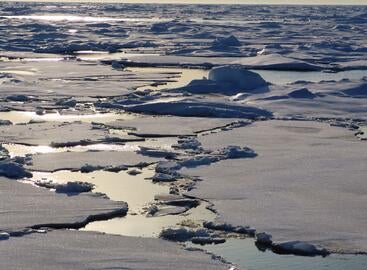
Ice floes coming together in the Arctic. (Pablo Clemente-Colon, Chief Scientist, National Ice Center)
<関連情報>
- https://news.ucr.edu/articles/2026/09/16/engineers-solve-puzzle-arctic-sea-ice-movement
- https://journals.aps.org/prl/abstract/10.1103/g8y2-8ytt
海氷輸送の異常な統計は衝突規則によって説明される Anomalous Statistics of Sea Ice Transport are Explained by Collisional Rules
Bryan Shaddy, P. Alex Greaney, and Bhargav Rallabandi
Physical Review Letters Published: 10 September, 2026
DOI: https://doi.org/10.1103/g8y2-8ytt
Abstract
Arctic sea ice fluctuates in response to its turbulent environment, leading to dispersion behaviors that are not well understood. We resolve this gap using simulations that model sea ice as a granular medium that responds to stochastic winds. Using only directly measured local environmental and ice properties as inputs, the model quantitatively reproduces the dispersion, velocity distribution, and power spectrum of sea ice observed in the Fram Strait. These transport properties are generic consequences of collisions between floes, which rapidly dissipate the energy injected by wind while shortening the mean free paths of floes. A Boltzmann transport kinetic theory yields further quantitative insight, recovering both the simulations and observations. Our findings connect floe-scale dynamics and local environmental noise to properties of sea ice at climate-relevant scales, while also establishing broader links to stochastically driven dissipative granular systems.