2026-09-14 ブラウン大学
<関連情報>
- https://www.brown.edu/news/2026-09-14/mars-interior-warm-spot
- https://www.nature.com/articles/s41586-026-10893-x
潮汐トモグラフィーにより、火星の地殻二分構造の下に熱異常が存在することが明らかになった Tidal tomography reveals a thermal anomaly beneath Mars’s crustal dichotomy
Alexander Berne,Nicholas Wagner,Isamu Matsuyama,Sander Goossens,Antonio Genova,Marc Rovira-Navarro,Amirhossein Bagheri,Chuan Qin,Angela Marusiak,Douglas Hemingway,Harriet C. P. Lau,Kar Wai Cheng,Shijie Zhong & Francis Nimmo
Nature Published:26 August 2026
DOI:https://doi.org/10.1038/s41586-026-10893-x
Abstract
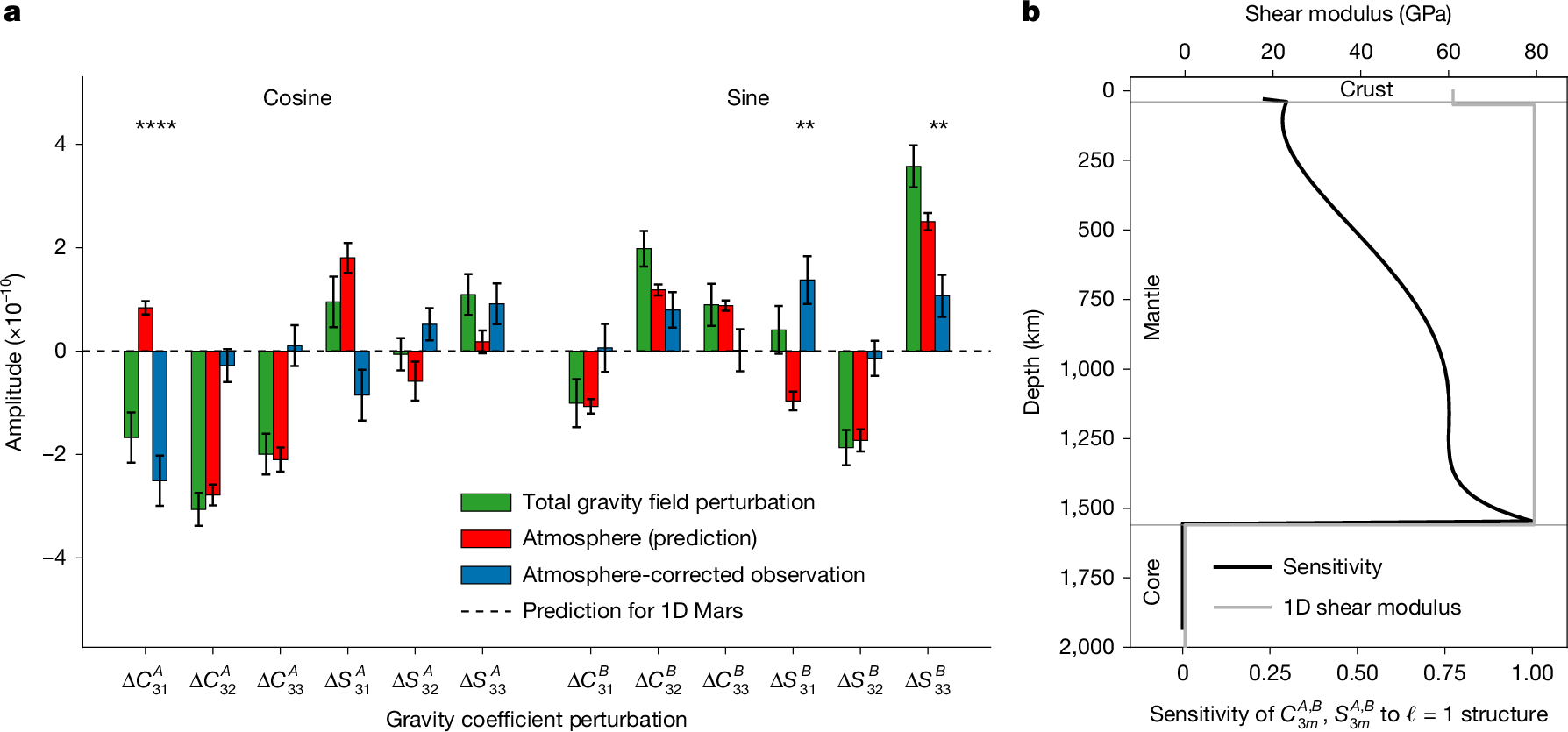
Mars undergoes seasonal tidal forcing as a result of its eccentric orbit and the tilt of its rotation axis relative to the Sun1. Response to this forcing produces temporal variations in the Martian gravity field and is sensitive to the internal structure of the planet2,3,4. Using tracking data from the Mars Global Surveyor (MGS), Mars Odyssey (ODY) and Mars Reconnaissance Orbiter (MRO) spacecraft5,6,7, we demonstrate that degree-3 components of the time-variable gravity field of Mars differ by up to 300% from predictions for a spherically symmetric planet8,9,10. These deviations can be explained if the effective shear modulus of the mantle varies by >20% over a roughly north–south pattern that closely aligns with the surface expression of the Martian crustal dichotomy11. On the basis of this correlation, we infer preservation of a 200–400 °C thermal anomaly in the present-day mantle below the southern highlands of Mars. This temperature variation could reflect regional mantle convection12,13 or insulation by the thick southern highlands crust of Mars that has persisted over several billion years14,15.