2026-09-14 テキサス大学オースチン校(UT Austin)
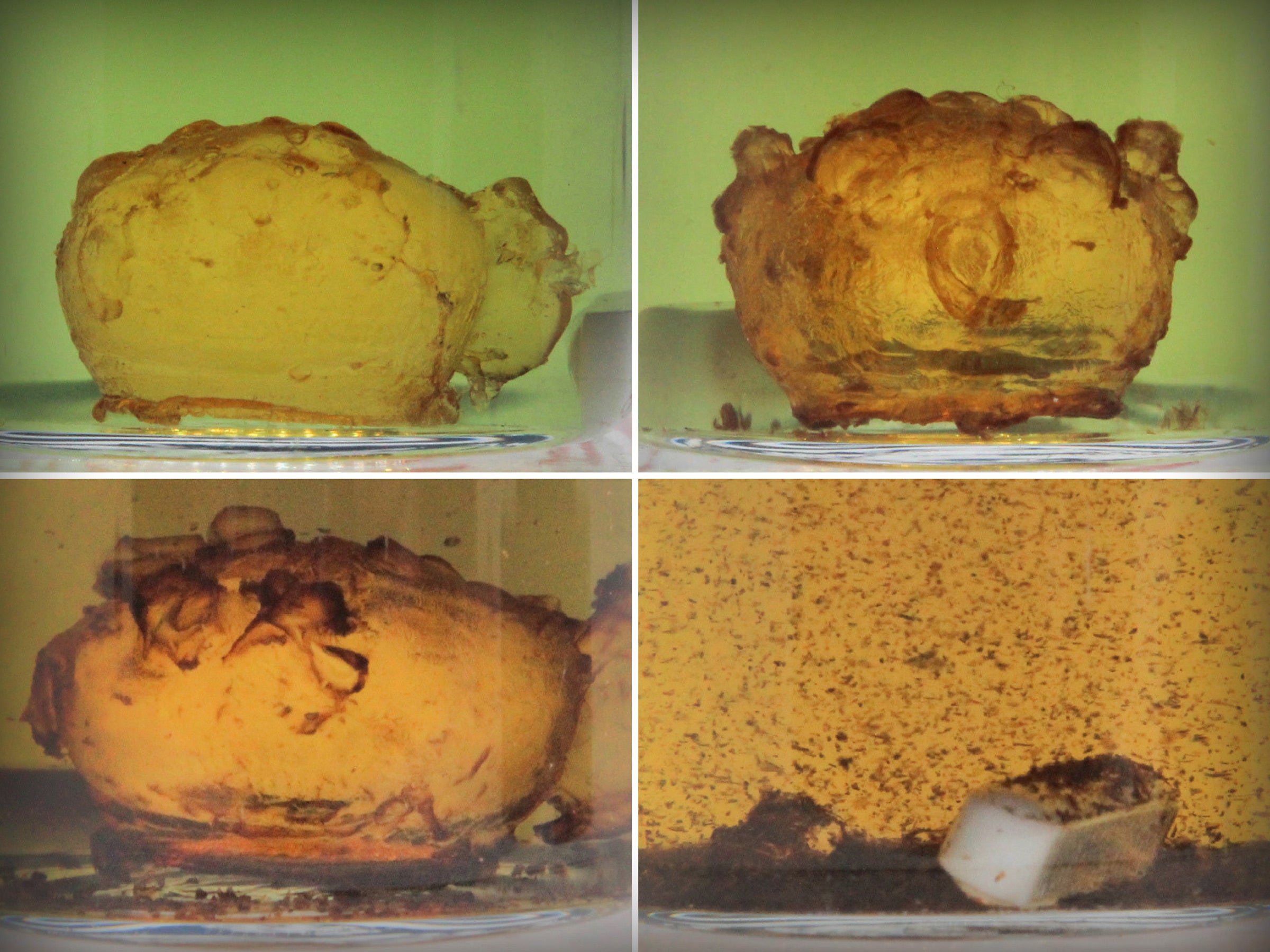
A 3D-printed pufferfish made of pDCPD undergoes deconstruction in a solution containing an eco-friendly solvent and ruthenium-based catalyst.
<関連情報>
- https://news.utexas.edu/2026/09/14/new-low-waste-chemistry-method-breaks-down-tough-to-recycle-plastics/
- https://www.science.org/doi/10.1126/sciadv.aef4204
ポリ(ジシクロペンタジエン)複合材料をリサイクルするための直接メタセシス分解 Direct metathesis deconstruction to recycle poly(dicyclopentadiene) composites
Keldy S. Mason, Meghan T. Kiker, Zhenchuang Xu, Tyler C. Price, […] , and Samuel C. Leguizamon
Science Advances Published:11 Sep 2026
DOI:https://doi.org/10.1126/sciadv.aef4204
Abstract
The permanent cross-links that give thermosets their strength and durability also make them difficult to recycle. Here, we present a green, scalable strategy for the chemical deconstruction of poly(dicyclopentadiene) (pDCPD) thermosets and composites using metathesis-based chemical recycling. Key findings include the identification of cyclopentyl methyl ether as a “green” processing solvent for mild deconstruction and an understanding of the catalytic fragmentation mechanism wherein both ring-closing metathesis and chain transfer pathways are present. The deconstruction protocol is shown to be effective for a variety of pDCPD samples produced via distinct ring-opening metathesis polymerization (ROMP) curing methods, including frontal-ROMP, photoROMP, and thermal ROMP, as well as with commercial thermoset formulations and fiber-reinforced composites. As a proof of concept for future translatability, embedded electronics, glass fibers, pristine carbon fibers, and >90% recovery of polymer fragments are demonstrated. Last, a detailed life cycle analysis indicates that this approach offers a viable (high credit) alternative to contemporary thermoset disposal and incineration, opening a path toward closed-loop recycling of high-performance pDCPD materials.